

In Brief
-
Early start: kids’ cards have become a mandatory attribute for modern schoolchildren in Kazakhstan, but apps for children often copy “adult” logic, missing their real interests.
-
Control vs. autonomy conflict: overprotection in the interface (total parental control over spending with no right to the child’s personal financial secrets) reduces the engagement of young users.
-
Gamification wins: children’s loyalty is won through game mechanics, clear savings goals, and bright, customizable design.
Issuing a first bank card to a child in Kazakhstan has become a standard step in fostering financial literacy. It is convenient for parents to send money for pocket expenses, and for children to feel like adults at the checkout. However, children’s interfaces in banking apps are often created without taking into account age psychology and the UX needs of the new generation.
Rocket Tech specialists researched the usage patterns of children’s fintech products and highlighted the key problems in the interaction between parents and children.
Brief Conclusion
Kids’ banking in Kazakhstan suffers from a lack of balance: apps are either too boring and overloaded with complex financial terms, or they overly restrict the child’s freedom. To successfully retain this audience, banks need to implement full-fledged gamification (rewards for savings, financial literacy quizzes) and give children a controlled space for independent financial decisions.
Key Barriers: Boredom, Overprotection, and Technical Limitations
-
Copying “Adult” UX/UI: Children think in images and game scenarios. Boring transaction lists, strict fonts, and the gray color schemes of adult super apps quickly bore a child. Without bright visual triggers and personalization elements (choosing avatars, themes), the app turns into a utilitarian “open-and-pay” tool.
-
Conflict Between Parental Control and Child’s Freedom: Parents’ desire to fully control every tenge often leads to the child avoiding using the card. The absence of a “secret piggy bank” or a zone for personal decisions in the app, protected from direct parental intervention, destroys the young user’s trust in the digital bank.
-
Complexity of Savings Mechanics: “Piggy Bank” sections are often made too primitively. Children quickly lose interest in saving if the process is not visualized (for example, as a progress bar toward buying a desired toy/game) and is not reinforced by rewards from the bank or parents.
Behavioral Models: From Fun to Forced Use
-
Gamer Model (Engaged Children): Actively use the app to complete tasks (e.g., “read an article — get a bonus”), save for specific goals, customize their cards, and compete with friends in their level of financial literacy.
-
Inertia Model (Passive Holders): Use the card only to buy lunch at school or pay for transit. They rarely open the app, check their balance reluctantly, and their financial behavior is managed entirely by their parents.
-
Resistance Model (Disappointed): Children who have faced strict limits from parents or technical failures (the card was blocked, a payment in the school cafeteria failed). They prefer to ask their parents for cash to avoid control and unnecessary stress in the interface.
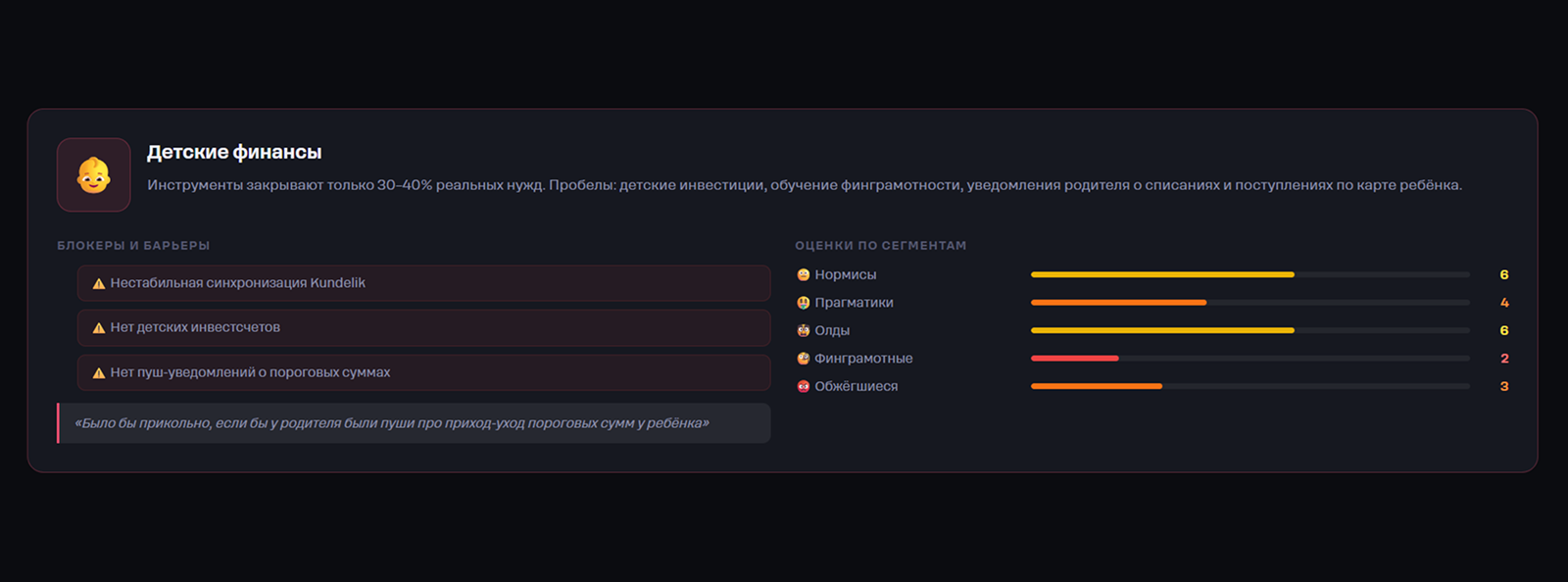
How It Looks in Practice
Twelve-year-old Alisher’s parents got him a kids’ card so he could pay for lunch in the school cafeteria and for transit. The first week was interesting, but the app turned out to be a scaled-down copy of an adult one: gray transaction lists, no avatars, and no goals. He abandoned the piggy bank—there was no visible progress and no reward. And when his parents set a strict limit and blocked a couple of purchases, Alisher started asking for cash again: it’s simpler and comes without the feeling that every tenge is being monitored. The app remained a “cafeteria card,” not a first experience with his own money.
Conversely: where the app speaks to the child in their own language, the scenario works. A child willingly saves for a specific goal if a progress bar is visible and there is a reward for financial literacy tasks, customizes the card, and competes with friends. The key is balance: the parent needs peace of mind and limits, while the child needs to feel that a portion of the money and decisions is truly theirs. A bank that gives both parties their share cultivates not a one-off “cafeteria card,” but a future loyal adult client.
Why It Matters
Creating kids’ banking is a long-term investment in a future loyal base of adult clients. The bank that can speak to children in their language while guaranteeing parents peace of mind and security will win.
FAQ
How to keep a child’s attention in a financial app?
Through gamification and a reward system. Task completion mechanics (e.g., “make 3 deposits in a week”) and interface customization work much better than standard text-based spending reports.
Why do children abandon cards in favor of cash?
Most often, this is a reaction to total parental control. If the interface does not leave the child a private zone for small pocket expenses or a personal piggy bank, they tend to retreat into the “cash” zone, which is invisible to parents.
How can a bank improve a child’s financial literacy?
By replacing long, boring articles with interactive quizzes, short stories, or video formats. Learning should be built into the app’s usage scenario, rather than looking like a school lesson.
How to keep a child in a kids’ bank for longer than a couple of weeks?
Give them their own decision-making zone: a piggy bank with clear progress toward a goal (a game, a scooter), rewards for financial literacy tasks, and a “pocket” amount that the child spends themselves, without needing approval for every purchase. Total parental control alienates them the fastest.
Original research source: Rocket Tech: Features of the user experience of children and parents in children's fintech in the Republic of Kazakhstan
