

-
Cognitive fatigue: Ad-heavy superapps and a lack of transparency during payment delays force users to keep backup cards in other banks.
-
Simplicity wins: Customer loyalty can no longer be bought with a multitude of buttons; the winning superapp will offer the calmest and shortest path to the result.
Kazakhstan has made an unprecedented leap in fintech: in just a few years, the country transitioned from cash dominance to nearly 88% penetration of QR payments and instant mobile transfers. Today, a banking app on a Kazakhstani’s smartphone covers all daily tasks—from paying for kindergartens and taxes to ordering groceries and buying airline tickets. However, high frequency of fintech service usage does not mean all users are absolutely satisfied or use the tools the same way.
A large-scale UX study by the Rocket Tech team identified key product barriers and five audience segments with different logic for interacting with digital money.
The Bottom Line
Almost everyone in Kazakhstan uses digital payments, and the debate is no longer about features, but about fatigue from unnecessary steps: cluttered interfaces, intrusive ads, and “interbank blindness,” where a person cannot see the balances of all their banks at once. Users split their capital for cashbacks, and loyalty is now retained not by the number of features, but by the simplicity, seamlessness, and stability of transactions.
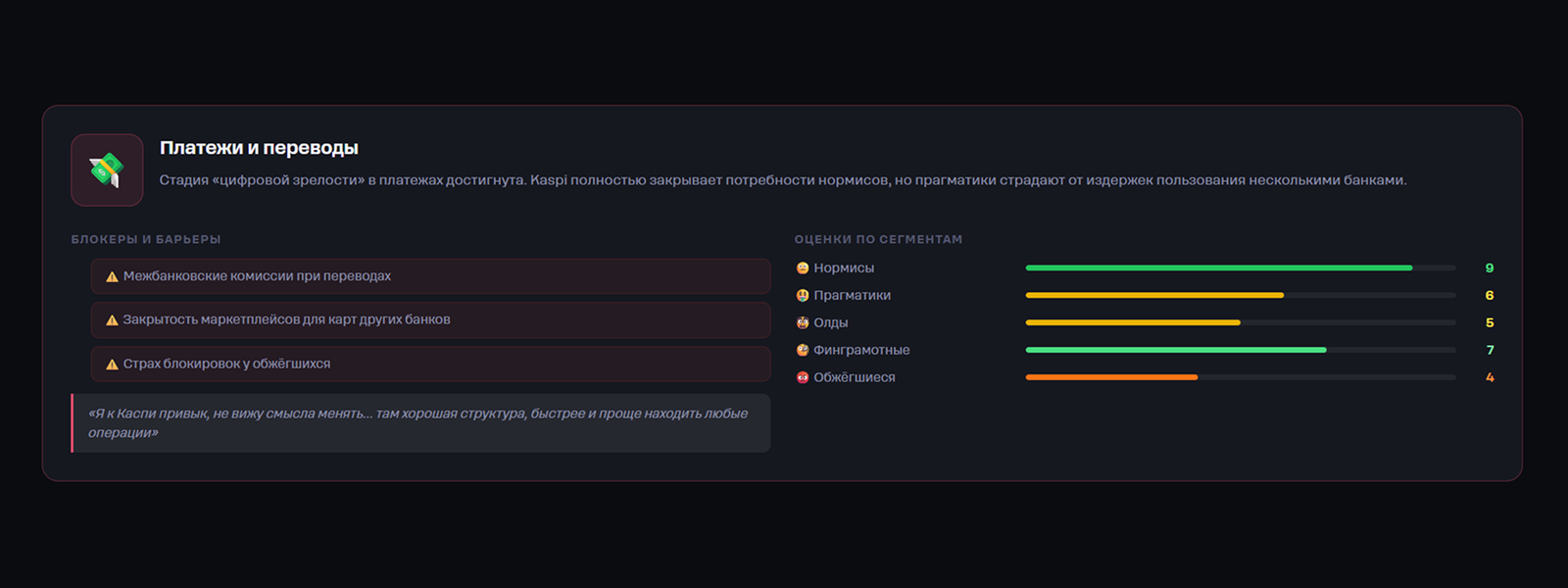
Key Barriers: Interbank Blindness and Fear of Failures
Cognitive Friction and Cluttered Interfaces
Modern superapps have turned into overloaded machines. Users experience cognitive fatigue from the abundance of banner ads, push notifications, and the pushing of additional services during the simplest operations. Consumers are tired of overthinking every step; they need the shortest and cleanest path from the intention to make a transfer to its completion.
The Phenomenon of “Interbank Blindness” and Capital Splitting
Due to rigid interbank barriers and a lack of end-to-end analytics, users are forced to split their capital among 3–4 financial institutions. They transfer money back and forth for higher bonuses, cashbacks, or favorable installment terms, but lose control over the big picture of their finances. The absence of a single screen displaying balances and expenses across all banks simultaneously creates what is known as “interbank blindness.”
Technological Fear and Processing Failure Trauma
Mass users often view any technological innovations in payments (such as biometrics or new transfer protocols) with suspicion—as a potential “place where everything can break.” The situation worsens if the bank fails to provide transparency: the lack of a real-time explanation for a “stuck” payment status causes clients to panic and switch to backup financial apps.
A single experience of a processing failure that blocks funds at a checkout or in a taxi leaves the user with deep psychological trauma, which can cause them to permanently abandon transfers within a specific ecosystem.
Behavior Models: From Habit to Total Self-Defense
In-depth interviews clearly segmented Kazakhstani users based on their attitude toward the transactional experience:
- The Inertia Model (Normies and Old-timers): The choice of payment tool here is dictated solely by habit or external circumstances, such as a payroll project. They are highly conservative, do not seek new ways, fear changing their usual payment routine, and use only basic functions. For them, any interface innovation is not a convenience, but additional stress.
- The Cold Calculation Model (Pragmatists and the Financially Literate): These users lack emotional attachment to a brand. They thoroughly know the rules for cashback accrual, limits on fee-free transfers, and interest rate dynamics. They use interbank transfers as an arbitrage tool, instantly redirecting cash flows to wherever conditions are currently better by even one percent. Retaining them with standard interface solutions is impossible—they need flexible control tools and real economic benefits.
- The Survival and Fear Model (The Burned): This is the most vulnerable and simultaneously the most critical part of the audience. They have a history of account blocks, erroneous deductions by banking systems, or aggressive behavior from customer support. Their financial behavior is a continuous defense. They distrust automatic deductions, disable all autopays, do not link cards to services, and strive to zero out the app balance immediately after completing a necessary transaction.
Why It Matters
In the Kazakhstani market, the winner will not be the bank with the most features, but the one with the shortest and calmest path: less advertising, honest transaction statuses, and predictability even during a failure. This, rather than the number of buttons, is what retains the client today.
FAQ
Why do users still manually transfer money between their accounts in different banks?
This happens due to capital splitting for short-term gains (cashbacks, promotions, installment terms) combined with a lack of cross-bank integration. Because of “interbank blindness,” users have to manually balance their accounts to optimize personal spending.
What undermines trust in payment services within a banking app the most?
The main trigger for distrust is a lack of transparency at a critical moment (for example, when a payment is “stuck” and the app does not show its real-time status) and past negative experiences with technical failures that left the client without funds at an inconvenient time.
What should the ideal payment service look like according to Kazakhstanis?
Respondents describe the ideal service as an “invisible assistant” that does not force unnecessary clicks, does not overload with ads, instantly and clearly informs about transaction statuses, and guarantees uninterrupted operation under any conditions.
Original research source: Rocket Tech: How Kazakhstanis use payments and transfers in banking ecosystems
