

In Brief
-
AI is everywhere: The integration of artificial intelligence into banking apps, support chats, and search engines in Kazakhstan is in full swing, but users still treat it as a trendy toy.
-
The distrust effect: The lack of explanation for how AI reaches a particular conclusion (especially in credit decisions or recommendations) causes user rejection.
-
Transparency wins: The winning service will be the one that makes artificial intelligence predictable, obvious, and leaves the right of final control to the human.
Artificial intelligence is no longer science fiction: it recommends music to us, approves loans, curates product selections, and tries to answer instead of support operators. However, the rapid implementation of AI technologies often outpaces users’ readiness to trust decisions made by algorithms.
The Rocket Tech team conducted a study on how Kazakhstanis interact with AI features inside familiar digital services.
Brief Conclusion
The main barrier to mass AI adoption in Kazakhstan is the “black box effect”—the user’s lack of understanding of how the algorithm makes decisions. Customers are tired of “stupid” chatbots masquerading as artificial intelligence and want to see AI as a transparent assistant that explains its actions and saves real time, rather than creating additional circles of hell in customer support.
Key Barriers: Useless Chatbots and the Fear of Losing Control
-
A wall of misunderstanding in support: Users experience irritation when, instead of a quick response from an operator, they are forced to communicate with an underdeveloped AI bot that does not understand the context of the problem and runs the customer in circles through standard scripts. This completely destroys trust in the entire brand.
-
Opacity of decision-making algorithms: When AI approves or rejects an application (for example, for a loan or installment plan), the user wants to know “why.” The lack of feedback in the interface (“You have been denied based on data analysis”) causes a feeling of unfair system bias.
-
Fear of algorithm “hallucinations”: Users are afraid to trust AI with important tasks (financial calculations, drafting legal documents, medical recommendations), knowing that neural networks can make mistakes and “hallucinate.” The absence of explicit links to primary sources of information within the AI assistant’s interface reinforces this barrier.
Behavioral Models: From Blind Delight to Hard Ignoring
-
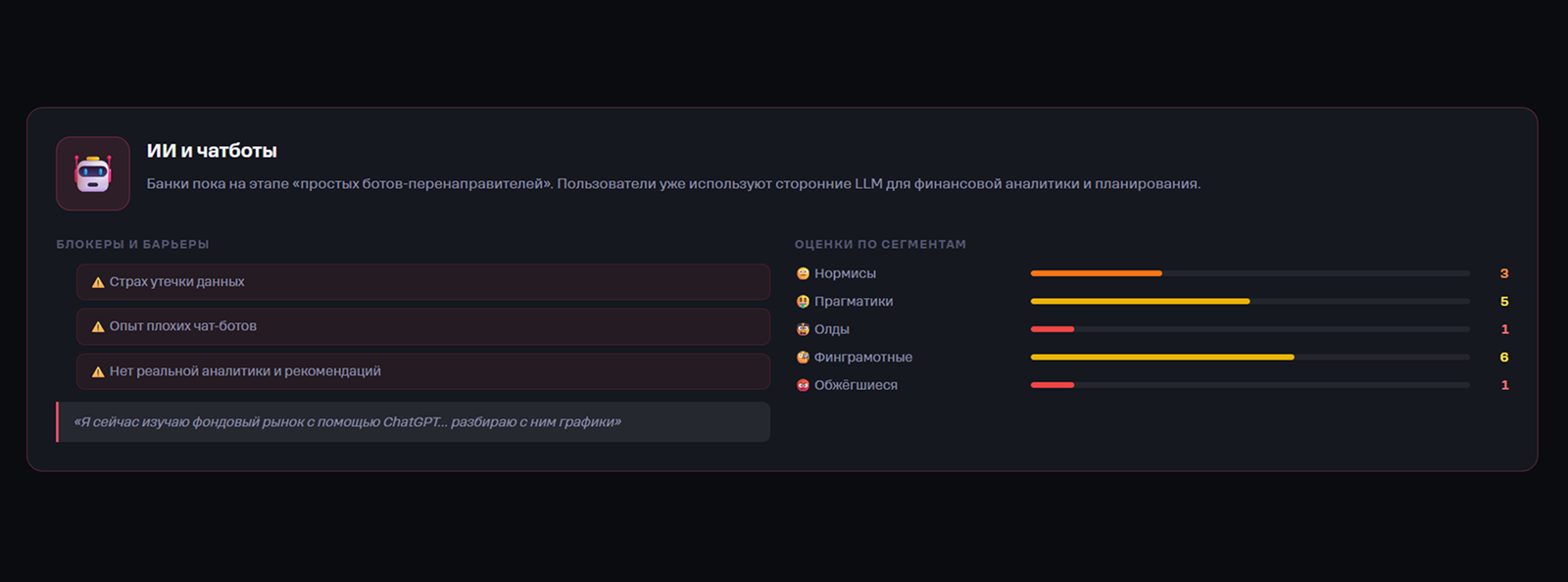
The Geek Model (Enthusiasts): Actively test all new AI features, use generative models for work and everyday tasks, and try to optimize their interaction scenarios with applications through voice assistants.
-
The Pragmatic Use Model (Skeptics): Turn to AI only when it provides a guaranteed and fast result (for example, summarizing a long text or doing a quick search by exact parameters). They instantly switch to a human if the algorithm starts to stall.
-
The Total Rejection Model (Conservatives): Fundamentally ignore any smart recommendation feeds, demand to disable “algorithm tracking” of their actions, and when encountering a chatbot in support, immediately type “OPERATOR” in all caps, striving to minimize contact with the machine.
How It Looks in Practice
Yerlan writes to bank support: a utility payment did not go through. Instead of an operator, there is a chatbot that suggests “checking the balance” three times and runs him through standard branches, not understanding the essence of the problem. Yerlan types “OPERATOR” in all caps—a trick familiar to many. And when the same bank denied him an installment plan via AI without a single explanation of “why,” the feeling of injustice only intensified. Yerlan is not against artificial intelligence—he is against the algorithm deciding for him in the dark and, on top of that, preventing him from reaching a live person.
It is telling that the same people calmly use AI when it is transparent and useful: summarizing a long contract, quick searching by exact parameters, or suggesting a product analogue. Rejection is caused not by the technology, but by the lack of control—when a bot replaces a live operator and when an algorithm delivers a verdict without explanation. A bank only needs two things: a prominent “operator” button at any point in the dialogue and a clear “why” under every AI decision. Then the “black box” turns into a trusted assistant.
Why It Matters
AI should help humans, not replace them where it is critical. The vector of development for future interfaces lies in creating explainable and empathetic artificial intelligence that treats the user experience with care and does not make people feel dumber than the algorithm.
FAQ
How to overcome user negativity towards support chatbots?
Give the customer the ability at any moment (via one prominent button) to switch the dialogue from AI to a live operator, without the need to go through mandatory questionnaire branches.
What is the “black box effect” in simple terms?
This is a situation where the user sees the final result of the AI’s work (for example, a denial of an installment plan), but the interface does not explain in any way based on what logical steps and factors this result was obtained.
How can an AI interface prove its reliability in analytical tasks?
By providing verifiable clickable links to information sources or documents on the basis of which the AI model formed its answer.
When are Kazakhstanis ready to trust an AI assistant?
When they see what the answer is based on and can switch to a human at any moment. Trust is built on transparency: a link to the source, a clear explanation of an application denial, and a prominent button to call an operator. Without this, even an accurate AI is perceived as a “black box.”
Original source of the research: Rocket Tech: Artificial Intelligence and Designing Explainable UX in Modern Interfaces
