

-
Transparent refunds: A multi-day delay in refunding out-of-stock items acts as a critical barrier and sparks major complaints.
-
Demand for smart receipt analytics: Advanced users prefer superapps that automatically categorize purchased goods for personal budgeting without manual entry.
Over the past few years, grocery and food delivery in Kazakhstan has evolved from a niche service to a mass consumption standard. Banking ecosystems have become the main gateway to e-grocery: ordering is integrated directly into superapps. This allows one-click purchases using linked cards and accumulated bonuses within a familiar interface. However, high usage frequency does not equal complete trust. Users react differently to order assembly quality, refund delays, and opaque receipts, which directly impacts loyalty to the banking platform itself.
The Bottom Line
Today, grocery delivery in Kazakhstan’s banking ecosystems is a battle for details amid fierce competition. User loyalty depends not on basic functionality, but on the accurate weight of loose goods, the speed of refunds for canceled items, and the depth of receipt analytics. The winning superapp will make online delivery as transparent and predictable as shopping at a local convenience store.
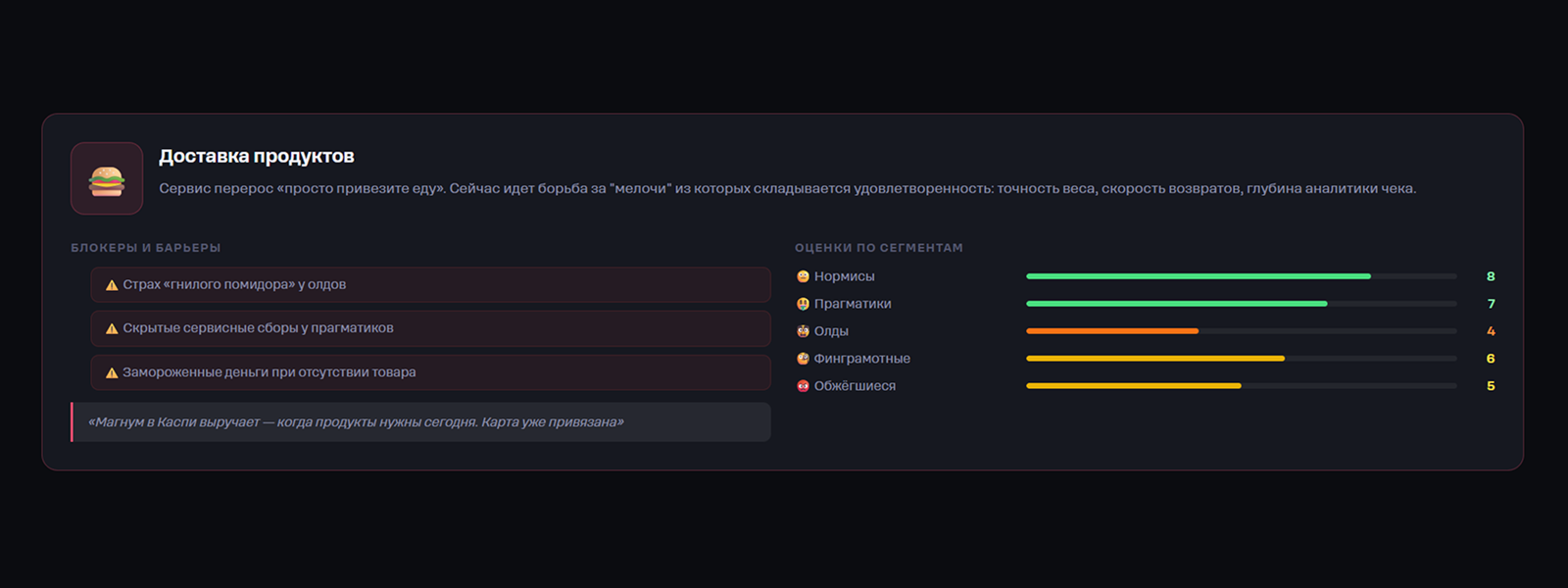
The evolution of e-grocery: from routine to freshness control
Basic needs: speed and habit
For the broader audience, ordering food has become a routine process where the habit of a familiar superapp interface and courier speed often outweigh loyalty to a specific bank brand. If the process runs smoothly, the user won’t switch to third-party aggregators.
Demand for deep financial analytics
The financially literate user segment expects full-fledged financial tracking from banking ecosystems. Their key e-grocery need is the automatic breakdown of grocery receipts by product category within the bank’s analytics, eliminating manual data entry in spreadsheets.
Key blockers and trust barriers in foodtech
Rocket Tech research identified specific fears and problems that prevent users from fully trusting superapp grocery orders:
-
Frozen funds for missing items: If an item is out of stock, the bank refunds the difference, which can take several days. The “money deducted, no product, waiting for a refund” scenario is a critical barrier and a major source of conflict for many clients.
-
Inaccurate weight conflicts: Discrepancies between paid and actual weight (for example, delivering bone-in meat instead of net weight) cause sharp conflicts. If the bank does not offer instant compensation in the support chat, trust in that ecosystem’s delivery drops to zero permanently.
-
Fear of hidden charges: Users hesitate to link cards to food delivery services, fearing the app will automatically charge tips or bag fees without explicit confirmation.
-
Lack of visual control: For the conservative audience, the main barrier remains the inability to pick products themselves. They will only trust the ecosystem if it guarantees assembly quality and “market-level freshness.”
How it looks in practice
Gulnara orders a week’s worth of groceries through her bank’s superapp. Half the basket is sold by weight: meat, vegetables, fruits. The order arrives—the beef is 200 grams lighter than on the receipt, and a couple of tomatoes are bruised. She will get a refund for the missing weight, but only after three days and a back-and-forth with support. Next time, Gulnara goes to Arbuz.kz, where weight discrepancies are compensated immediately, right in the chat. A bank that automatically recalculates weight upon assembly and instantly refunds the difference wins her over not with price, but with peace of mind: she stops double-checking every receipt and meticulously inspecting bags at the door.
Why it matters
Grocery delivery is no longer just an additional bank feature; it has become a powerful driver of daily active users (DAU). However, any logistical flaw (from slow refunds to poor assembly) automatically hits the bank’s reputation. To retain clients, ecosystems must shift from simply delivering baskets to building trust in critical scenarios: guaranteeing instant refunds, accurate weights, and integrating purchases into a smart personal budget control system.
FAQ
Why do users fear linking cards to superapp delivery services?
The main fear is hidden charges. Clients worry the banking app will automatically deduct funds for non-obvious services, like courier tips or packaging bags, without their direct consent.
What undermines loyalty to a bank’s delivery service the most?
Frozen funds for missing items and weight errors. If a bank takes days to refund a missing product or fails to instantly compensate for weight differences in meat or vegetables, the client views this as a critical failure and abandons the service forever.
What do advanced users miss in grocery delivery?
They critically lack deep receipt analytics. Financially literate users want the superapp to automatically break down the final grocery receipt into specific product categories within the financial tracking system, eliminating manual data entry.
Why do Kazakhstanis easily order prepared food but remain cautious with groceries?
A prepared meal is evaluated immediately and costs little—the risk is low. Groceries are bought for the week ahead: accurate weight, perishables’ freshness, and fast refunds for missing items matter here. One mistake with fresh meat or milk, and the client returns to their familiar neighborhood store.
Original research source: Rocket Tech: How Kazakhstanis order food and groceries through banking ecosystems
