

-
Catalog overload: Integrating supermarket storefronts into banking superapps often suffers from poor navigation. What works for financial services proves completely unsuitable for picking tomatoes or fresh bread.
-
Last-mile criticality: Users forgive minor interface bugs but show zero tolerance for missed delivery deadlines and unapproved item substitutions.
Integrating food delivery into Uzbekistan’s banking ecosystems attempts to cover the highest-frequency human need. While financial transactions happen a few times a week, grocery ordering can be daily. However, superapps face fierce competition from specialized delivery services built entirely around logistics and inventory management.
Bottom Line
Directly embedding a supermarket catalog into a banking app fails to deliver the expected conversion. To make grocery delivery a daily active user (DAU) driver, banks must radically rethink product visualization, cart management, and transparent communication during order assembly. Trust here is won through predictability and freshness, not cashbacks.
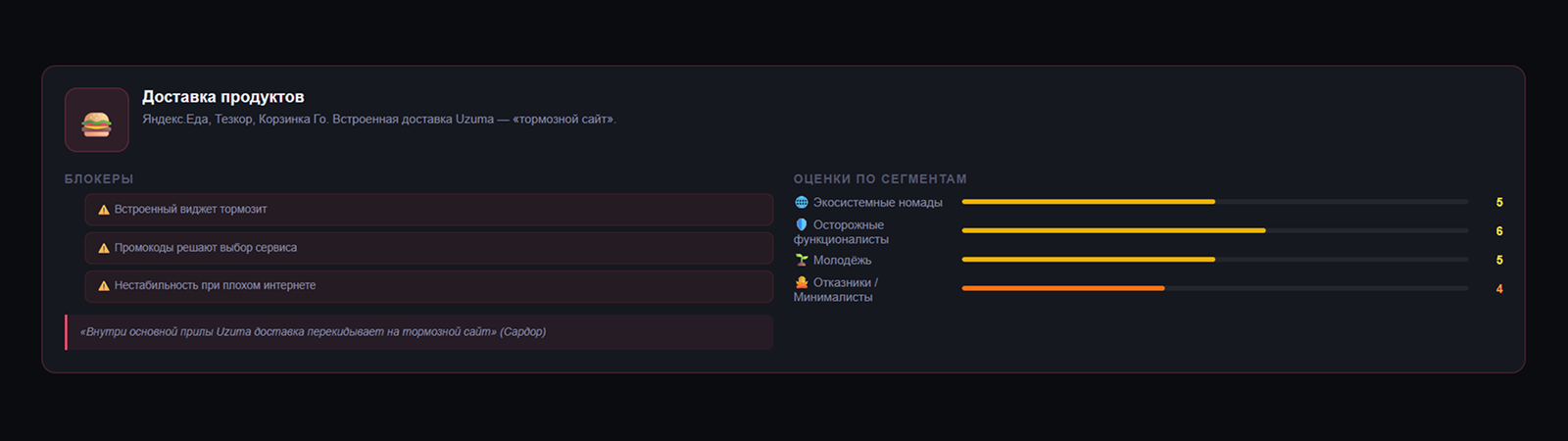
Key Barriers: Complex Navigation and Distrust in Pickers
Barrier 1: Architectural Dissonance and the Missing “Smart” Storefront
Banking apps are inherently built for transaction lists and tables. Forcing tens of thousands of stock keeping units (SKUs) from partner supermarkets into this same interface creates navigation chaos. Users complain about illogical categorization—dairy products ending up next to household chemicals—and search engines failing to recognize synonyms or brands typed in Cyrillic and Latin. The absence of standard e-grocery filters (by weight, brand, or dietary needs) makes assembling a large cart unbearably slow.
Product insight: The grocery delivery interface within a superapp must be completely isolated from the “banking” design system, favoring a classic retail format. Implementing predictive search that suggests adding familiar items based on past purchases cuts checkout time by a factor of three. Features like “Saved carts” or “Repeat past order” are critical, as up to 70% of a family’s regular grocery run consists of the exact same basic items.
Barrier 2: Opaque Substitutions and Distrust in Fresh Produce
The main psychological barrier to ordering vegetables, fruits, and meat is the fear of receiving poor-quality or spoiled goods. At a bazaar, buyers pick the best produce themselves; in an app, they delegate this to a stranger. The situation worsens when an item is out of stock and the picker substitutes it at their own discretion without asking the client, triggering sharp negativity and abandoned carts.
Product insight: This problem is solved by introducing an interactive “Approve substitutions” flow directly in the superapp chat. When a picker cannot find an item, the client should receive a push request with a photo of shelf alternatives and two buttons: “Substitute” or “Remove from cart.” Adding a “Comment for picker” option (e.g., “pack green bananas” or “pick softer tomatoes”) creates an illusion of personal control and radically boosts trust in the service.
Behavior Models: From Strategic Planning to Impulsive Snacking
-
Family strategists: These users (mostly parents) buy groceries once a week for large amounts. Their average check is high, but they are extremely demanding regarding assortment, precise delivery time slots, and bulk discounts. They value the ability to split payments among family members or use joint family accounts.
-
Situational consumers (Darkstore audience): They order little but often (ready meals, snacks, drinks). Their main trigger is delivery speed (15 to 30 minutes). If a banking app cannot provide express delivery, they instantly switch to specialized services, even if those lack banking cashbacks.
Why It Matters
E-grocery is the glue that binds a user to an ecosystem. If a bank links payments, credit limits (like BNPL for large holiday runs), and reliable fresh food delivery into a single scenario, it secures a client with maximum retention.
FAQ
Why do specialized delivery services often beat banking apps?
They have better last-mile logistics, and their interface is entirely focused on food (large, vibrant photos, fast search), whereas in a banking app, it is just one of many tabs.
Will massive cashbacks save a bad delivery interface?
Only during initial acquisition. If a user receives bruised vegetables or waits three hours for a courier instead of one, no bonus percentage will bring them back.
What matters more for grocery delivery in a superapp: prices or deadlines?
Deadlines and predictability. A difference of a few thousand soums is forgiven; a courier arriving two hours late or an unauthorized item substitution is not. Users return to services where orders arrive on time and exactly as assembled.
Original research: How Uzbekistanis use grocery delivery in banking ecosystems