

-
SME credit focus: The need of small and medium-sized businesses for convenient financial tools dictates new standards for ecosystems.
-
Transparency wins: Users choose super apps where cross-transfer fees are absent or minimal.
Uzbekistan’s market shows rapid growth in digital transactions. In a short time, financial apps have evolved from simple utilities into personal and business finance management centers. But truly seamless payments are still a long way off: infrastructure quirks and ingrained habits get in the way.
Bottom line
Despite the rapid penetration of p2p transfers, Uzbekistanis continue to face barriers in the form of fees and infrastructure fragmentation. Customer loyalty now depends on a bank’s ability to offer a single, transparent interface for all transaction types, including the integration of b2b and b2c scenarios.
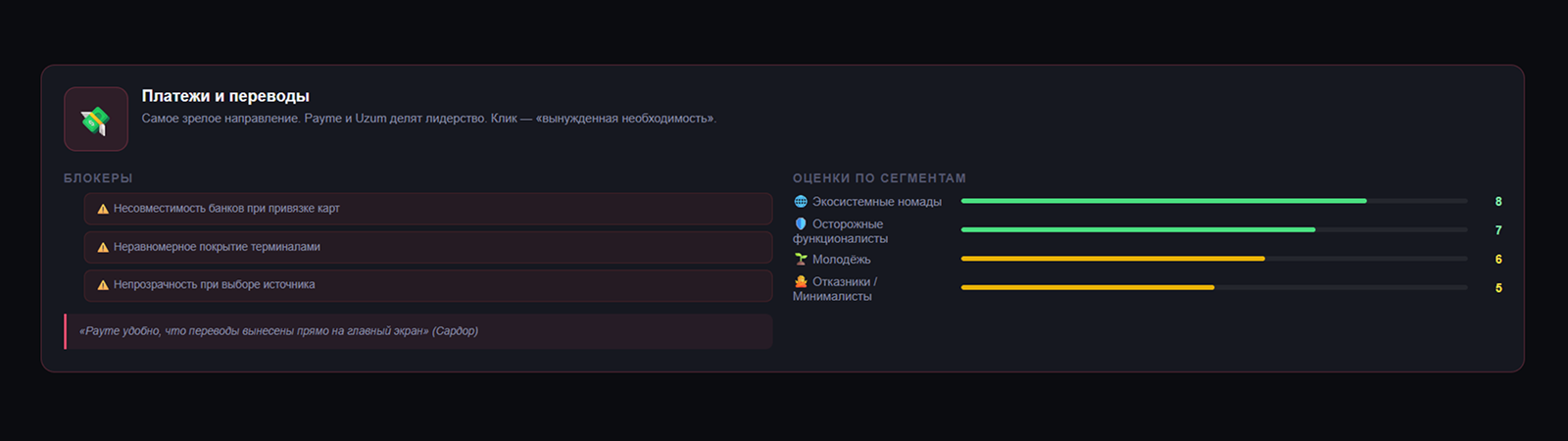
Key barriers: Interbank blindness and SME gaps
Barrier 1: Interbank fees and network fragmentation
The presence of two major national payment systems creates confusion during transfers. Users often face unexpected fees when sending money from one system to another within the same or different banks.
Product insight: Ecosystems implementing end-to-end payment routing capture market share. Visually highlighting fee-free corridors before the user enters an amount is crucial: a single transfer screen that automatically selects a fee-free route removes the main source of errors and distrust.
Barrier 2: The gap between personal and corporate finance
Entrepreneurs have to use different apps for personal needs and business management, which slows down settlements with counterparties.
Product insight: Blind testing of SME credit options (using products from players like Tenge Bank as an example) shows that microbusinesses critically need the ability to switch between a sole proprietorship account and a personal card in a couple of clicks. Switching between a business account and a personal card in a few taps and transparent scoring directly in the app noticeably increase business segment engagement.
Behavior models: From caution to transit
-
Cautious traditionalists: Use the app only to pay for utilities and phone bills. They avoid p2p transfers out of fear of making a mistake and sending money to the wrong place.
-
Multi-vector arbitrageurs: Actively use cards from 3–4 banks to minimize fees, juggling balances through transit accounts.
How it looks in practice
A bakery owner in Tashkent accepts payment in three ways: a Click QR code at the checkout, a card transfer via Payme “for friends,” and a terminal that reliably reads Uzcard but acts up with Humo. In the evening, he manually reconciles three revenue sources. His personal card is in one bank, his business account in another, so settling with the flour supplier means a transfer with a fee and an extra call to the accountant.
His regular customer keeps two cards in her wallet: a “salary” Humo card and a Uzcard “for the bazaar”—in her neighborhood, half the terminals accept only one system. Before a large transfer, she first checks if the route will eat up a fee, and if it does, she goes to an ATM for cash.
Both stories are about the same thing: while the payment infrastructure is fragmented, the user acts as the router. A super app that hides this complexity under the hood—automatically choosing a fee-free corridor, showing the final amount before confirmation, and switching the business account in two taps—will capture both everyday payments and business turnover.
Why it matters
Payments are the customer’s most frequent point of contact with the bank: this is where trust in the entire ecosystem is built or broken. As long as the user has to remember which card will “go through” a specific terminal, no service built on top of payments will truly work. Whoever removes this routine first will earn the status of the primary app.
FAQ
Why do users keep funds on different cards?
Due to differences in the acceptance of Uzcard and Humo systems in the regions, and to bypass fees on p2p transfers.
What is most annoying in the transfer interface?
The absence of the final amount including the fee before confirming the payment.
How do SMEs adapt to super apps?
Microbusinesses need credit and payment solutions in a single window—without clunky corporate internet banking platforms.
Why does Uzbekistan have two payment systems instead of one?
Uzcard and Humo developed as separate national projects with different processing centers. For the user, this results in differences in card acceptance and fees. Merging the systems has been discussed for years, but for now, banks are solving the problem on their end with end-to-end transfer routing.
What is end-to-end payment routing?
A mechanic where the app itself chooses the optimal transfer path between Uzcard, Humo, and accounts at different banks based on price and speed. The user sees a single “Transfer” button and the final amount, rather than a zoo of tariffs.
Original research: How Uzbekistanis use payments and transfers in banking ecosystems