

Brief summary
For WealthTech services to become mass-market, banks must radically simplify the interface of brokerage apps, hiding complex analytics under the hood. Education must be built right into the purchasing process, and the user’s first steps must be secured with micro-investments to let them feel the market mechanics without the risk of losing large sums.
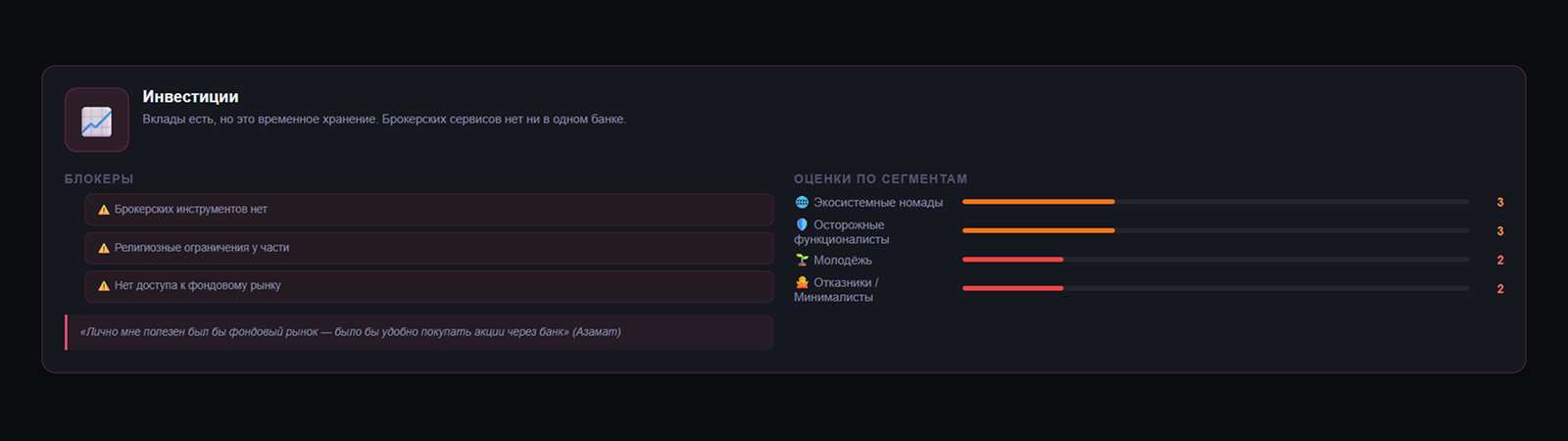
Key barriers: terminology and the fear of the first step
Barrier 1: Toxic professional interface
When a beginner opens the investment section, they expect to see a marketplace (like a storefront with goods), but instead they face Japanese candlestick charts, order books, and acronyms like P/E, EBITDA. This “terminal syndrome” forces the user to immediately close the app, feeling incompetent.
Product insight: The interface must adapt to the investor’s level. For beginners (85% of the audience), the storefront should look like product cards in an online store with clear human descriptions: instead of “Ticker UZCE” — “National Bank Shares. Historical yield 15% per annum”. The transition to complex charts should be hidden behind a special “PRO Mode” switch.
Barrier 2: The psychological barrier of the first trade
Even after opening a brokerage account, users may not make a single trade for weeks, afraid to press the “Buy” button and lose money due to volatility or hidden fees.
Product insight: Lowering the entry barrier through micro-investing and gamification. Implementing an “Invest-piggy bank” feature that automatically rounds up debit card spending (spent 45,000 sum, 50,000 is deducted, and 5,000 goes to buy a piece of gold or a mutual fund). When a person sees that they have become an investor without noticing it and their portfolio is slowly turning green, the fear of the first independent trade disappears.
Behavioral models: conservatives and crypto-enthusiasts
-
Conservative savers: Their experience is limited to sum and foreign currency deposits. They are extremely sensitive to the risk of losing the investment “principal”. For them, the ideal digital product is buying measured gold bars in the app with physical delivery or buying guaranteed government bonds with a fixed coupon.
-
Aggressive beginners: An audience that arrived on the wave of hype around cryptocurrencies and local IPOs. They are risk-tolerant and want high returns here and now. Social mechanics (social trading) are critically important to them — the ability to see the portfolios of successful traders within the ecosystem and copy their trades (Copy-trading).
How it looks in practice
A manager from Tashkent kept his savings “as is customary” for years: dollars at home, a bank deposit, and a plot of land “for the future”. The round-up feature made him an investor: the superapp offered to transfer the change from purchases into a piggy bank, and convert the piggy bank into grams of gold. Six months later, he was surprised to find a “portfolio” and consciously opened the investment section for the first time.
His colleague took a different path — through halal investments: it is a matter of principle for him that the instruments comply with Islamic norms, and the appearance of filtered “halal storefronts” removed the main internal barrier. Both are united by one thing: neither would have reached the “exchange” through an order book of quotes and Japanese candlestick charts.
The first money in WealthTech enters not through a trader’s terminal, but through familiar metaphors — a piggy bank, gold, a goal. Complex instruments become the second step when the portfolio is already “turning green” and the fear of the first trade has been overcome.
Why it matters
Investment products generate high commission revenue and retain capital (AUM) within the bank’s perimeter. A client who has built a diversified portfolio of securities in a superapp almost never leaves for competitors due to the complexities of transferring assets to another broker.
FAQ
What should be the minimum entry threshold in the app?
The lower, the better. The ability to start investing with an amount of 50,000 sum breaks the stereotype that the stock exchange is only for the rich.
How to help users when the market falls?
UX communication is critically important during drawdowns. The app shouldn’t just glow red. An AI assistant should send calming push notifications with educational content (“Why a market correction is normal and a time to buy assets at a discount”).
How important is Islamic fintech for Uzbekistan?
A significant part of the audience consciously avoids instruments with interest income. Halal filters, sukuk, and gold instead of bonds are not a niche option, but a way to open the capital market to millions of users who would otherwise stay in cash.
Original source of the research: How Uzbekistanis use investments in banking ecosystems