

Key Takeaway
The main requirement of users for transport services within ecosystems is zero cognitive and physical friction. The app must anticipate the client’s need to pay for the fare depending on their geolocation and ensure the payment triggers in fractions of a second. Otherwise, clients revert to using physical transport cards or cash.
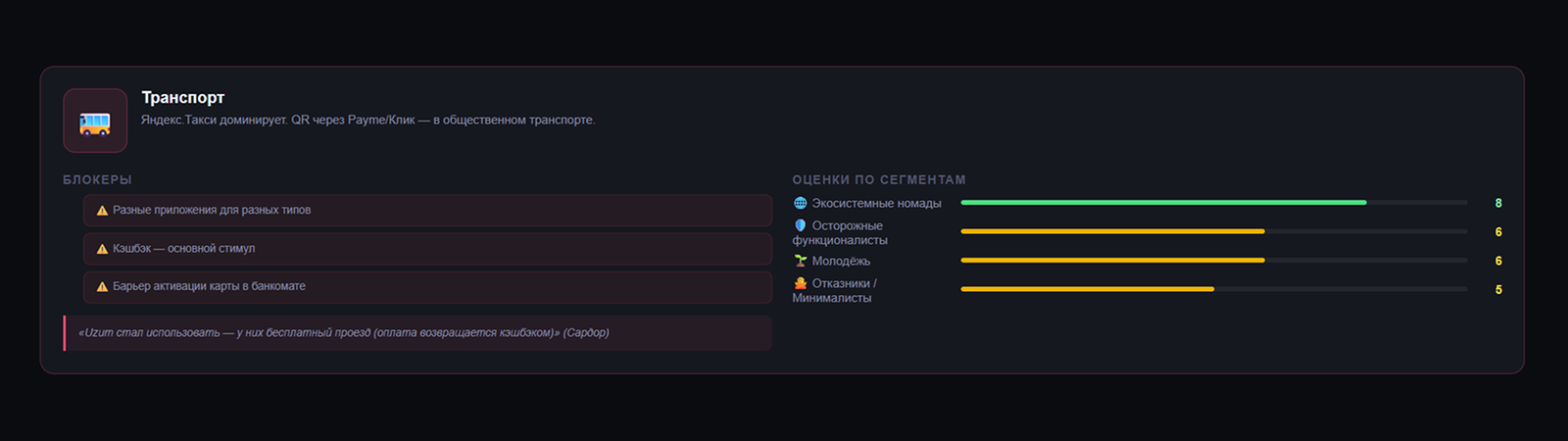
Key Barriers: Slow Interfaces and Service Isolation
Barrier 1: The “Long Click” Problem at the Turnstile
During rush hour in the Tashkent Metro, a passenger has literally 2–3 seconds to pay the fare. If this requires unlocking the phone, finding the bank icon, waiting for the splash screen to load, entering a PIN code, going to the “Payments” section, and generating a QR code—it is a fiasco. Users experience immense social stress by holding up the line, which forms a persistent negative attitude toward the ecosystem.
Product Insight: Access to the transport QR code or NFC payment should be brought to the smartphone’s lock screen or implemented via widgets (Quick Actions), bypassing full authorization in a heavy app. Geofencing (location tracking) can be a game-changer: as soon as a client approaches a metro station, the app itself should send a push notification with a ready dynamic QR code for a one-tap payment.
Barrier 2: Fragmentation of Travel Scenarios
Inside superapps, buying a ticket for a high-speed train (for example, “Afrosiyob”) and calling a taxi to the station are two completely unrelated processes. The user has to calculate the time themselves, switch between tabs, and enter the same addresses. Thus, the potential for cross-selling and a seamless travel scenario is lost.
Product Insight: Implementing the MaaS (Mobility as a Service) concept. If a user buys a train ticket to another city, the ecosystem should automatically offer them a “Connected Route”: book a taxi to the departure station for a time that accounts for traffic jams, and immediately offer a car rental or transfer option in the arrival city. A single “Pay for the entire route” button significantly increases the average check.
Behavioral Models: Daily Commuters and Rare Travelers
-
Daily commuters: Students and office workers who use buses and the metro daily. Micro-savings are critical for them: they actively monitor promotions, bonus rides, and transport cashbacks. For this group, the presence of a virtual transport card inside the superapp with auto-replenishment of the balance is important.
-
Comfort travelers: They exclusively use taxi aggregators integrated into the bank and fly on airplanes. Their priority is status, comfort, and earning premium miles. It is important for them to be able to pay for a business-class trip in installments (split payment) or with accumulated ecosystem points.
How It Looks in Practice
A morning for a student from Chilanzar: a bus to the metro, two stations, then a minibus. At the turnstile, she taps her phone—and if the payment works instantly, the day starts well. But if the app requests an update or loses network connection underground, a queue grows behind her, and her hand automatically reaches for the plastic ATTO card, which always works.
In the evening, she tops up ATTO via Payme and checks if the cashback for the morning trips has been credited. In total—three different apps for one task: “to get there.” A superapp that assembles the entire transport scenario—a virtual card with auto-replenishment, a QR code that works without a network, and a trip history next to the cashback—will become an app opened twice a day without any marketing.
Why It Matters
Transport is the gateway to the ecosystem. If a client gets used to paying for fares through your superapp twice a day, you get guaranteed attention to banners, stories, and cross-products. In the competitive fintech market of Uzbekistan, this is the cheapest way to stay in front of the client’s eyes.
FAQ
What stops people from completely abandoning physical cards in transport?
The fear that there will be no internet connection in the metro and the app will not load. Banks need to implement offline generation of payment tokens.
Why are taxis ordered less often in a bank app than in Yandex?
Habit and UI patterns. In specialized apps, the map and the car arrival are the main and only actions. In a bank, you still need to “get to” the taxi order through layers of menus.
Does card payment in transport work outside Tashkent?
Coverage is growing unevenly: in the capital, the metro and buses are paid for by card or phone; in the regions, digital payment is currently limited to specific routes. This holds back the transition to “phone instead of wallet” on a national scale.
Original research source: How Uzbekistanis pay for transport in banking ecosystems