

-
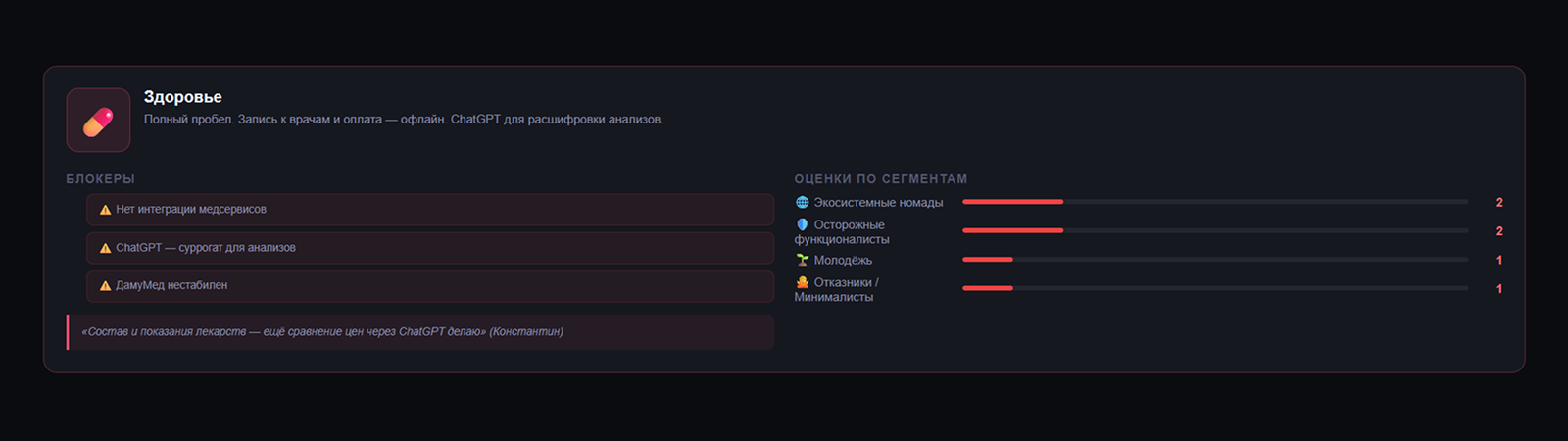
Friction in doctor appointments: The lack of unified medical information systems (MIS) in clinics makes online booking through a bank unreliable, as schedules often do not match reality.
-
The insurance blind spot: VHI (voluntary health insurance) has huge potential, but users do not understand how to use it within a super app.
The Health & MedTech category is one of the most complex yet promising frontiers for Uzbekistan’s banking ecosystems. Health is a basic need that people are willing to spend significant amounts on, often using installments and credit. However, the medical services market is highly fragmented, and bringing it under the roof of a single financial interface is a serious UX challenge.
Key Barriers: Data Fragmentation and Distrust of Telemedicine
Barrier 1: The Illusion of Online Booking (UX Gap)
Banking apps often feature a storefront of clinics, but when trying to book an appointment, the user simply leaves a “request,” after which a clinic administrator calls them back. This destroys the magic of the super app: the client expects instant booking confirmation but gets a classic offline experience waiting on the line.
Product insight: Integration must be deep, using the clinics’ MIS APIs. The user should see the doctor’s actual available slots—like seats in a movie theater—and book them in one click. Implementing pre-authorization of funds on the card for the appointment reduces the no-show rate at clinics, benefiting ecosystem partners.
Barrier 2: Opaque VHI Policies
Users who buy health insurance through a bank often cannot find the list of available services. Policies are multi-page PDF documents written in legalese. In the critical moment of illness, a person cannot quickly figure out if their insurance covers a specific test or an ambulance call.
Product insight: The VHI policy should be digitized as an interactive checker. The user types a symptom or procedure name into the super app’s search, and AI instantly replies: “MRI is 100% covered by your insurance. The nearest partner clinic is 2 km away. Book for 14:00?” Translating insurance products into a conversational interface exponentially increases their value.
Behavior Models: Reactive Patients and Biohackers
-
Reactive consumers (Treating symptoms): They only visit the health section when they are already sick. For them, the critical features are online pharmacy aggregation with price comparison and express delivery (under 1 hour) of over-the-counter drugs, as well as the ability to get a quick online consultation with a general practitioner to open a sick leave certificate.
-
Conscious biohackers (Preventive medicine): They focus on check-ups, vitamins, fitness services, and dentistry. They have a high average ticket and actively use installments for expensive examinations. For this group, it is important to visualize their health dynamics and integrate the banking app with pedometer data (Apple Health/Google Fit) to issue extra bonuses for activity.
How It Looks in Practice
It’s night, and a child has a fever. The mother opens the super app: in the pharmacy section, she finds an antipyretic, compares prices at three nearby locations, and orders one-hour delivery. This is the best scenario in the “Health” category—urgent, transactional, with obvious value. It is also almost the only one that works consistently.
A week later, the same mother tries to book her child an appointment with a pediatrician through the same app. The clinic storefront looks nice, but instead of available slots, there is a “leave a request” form. Forty minutes later, an administrator calls back suggesting she “come in around nine.” The magic breaks: the app turns out to be just a form.
Meanwhile, the corporate VHI policy sits as a PDF file in her email. The family will only find out what it covers during the next illness by calling the insurer. Three scenarios from one family map out the entire category: pharmacies already work, doctor appointments work halfway, and insurance exists only on paper.
The void left by the bank is increasingly filled not by a clinic, but by ChatGPT. Parents describe their child’s symptoms to the chatbot, translate test results, and clarify dosages. It answers instantly, in Russian and Uzbek, without queues or a condescending tone. Technically, this is not medicine and is fraught with errors, but in practice, the AI assistant has become the first point of contact with “health” for many. For super apps, this is a direct challenge: the client’s first medical interlocutor is an external service, not the ecosystem’s built-in assistant. Whoever teaches the app to safely suggest which specialist to see, which drug is in the nearest pharmacy, and whether a visit is covered by insurance will capture this contact. The rest will be left playing the role of a payment terminal for someone else’s advice.
Why It Matters
Integrating HealthTech builds emotional brand loyalty. A bank that helps quickly find rare medication for a child or books a doctor without a single phone call stops being just a financial institution and becomes a quality-of-life partner.
FAQ
Are people ready for telemedicine in a banking app?
Trust levels remain low. Telemedicine works better as primary triage or for interpreting test results, rather than as a replacement for a full examination.
How should expensive medical services be promoted?
Exclusively through 12–24 month installments. Dentistry, aesthetic medicine, and pregnancy management are ideal candidates for financial split products.
Where should a bank start in the “Health” category?
With pharmacies: this is a high-frequency, clear scenario with existing logistics. Doctor appointments and digital policies require deep integrations with clinics and insurers—they are better added as a second step, once the habit of managing “health in a super app” is already formed.
Original research source: How Uzbekistanis integrate health into banking ecosystems