

Key Takeaway
The success of apparel shopping within banking ecosystems directly depends on financial levers. But to turn one-off purchases into a regular habit, superapps need to overcome barriers related to logistics infrastructure and the convenience of visual product selection.
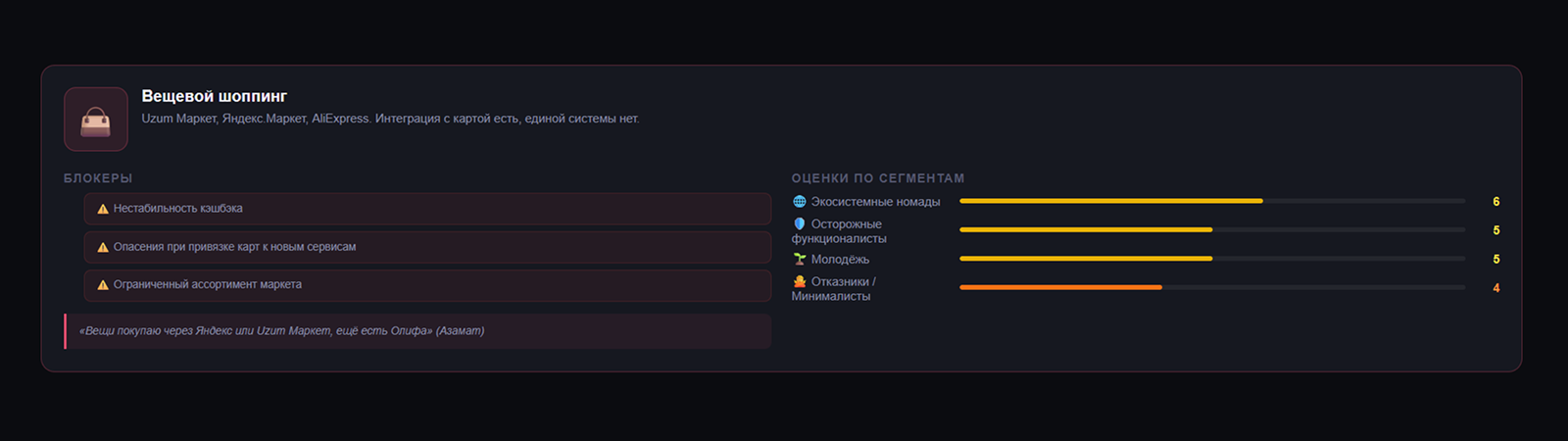
Key Barriers: Logistics and Utilitarian Design
Barrier 1: Unpredictability of Delivery Times and Returns
Users complain that order statuses in banking apps are often updated with a delay, and the process of returning an unsuitable item turns into a bureaucratic quest.
Product Insight: The development of e-commerce within ecosystems is severely hindered by logistics-level problems. Integrating banking marketplaces with modern 3PL operators and opening bonded warehouses for cross-border trade is a critical factor. Such infrastructure will reduce the delivery time of foreign brands by 2–3 times, radically improving the user experience.
Barrier 2: “Banking” UX in Retail
Interfaces originally designed for financial transactions handle the task of “emotional” shopping poorly. Product filters, photo galleries, and reviews are implemented too utilitarianly.
Product Insight: The marketplace storefront in a superapp should inherit from classic e-com, not from payment history. Recommendation feeds and video reviews right in the product card bring the experience closer to familiar marketplaces—and noticeably increase conversion.
Behavioral Models: Hunters and Skeptics
-
Limit Hunters: They visit the ecosystem’s marketplace only when they are approved for a favorable installment limit. They select a basket strictly for this amount—and if the limit expires unused, the reason to open the shopping section disappears with it.
-
Skeptics: They prefer offline fitting at bazaars and in malls, and only check prices or look for basic items that do not require a perfect fit in the app. Only free, no-questions-asked returns and honest product photos can pull them online.
How It Looks in Practice
A student from Samarkand has her eye on some sneakers. Then comes a typical fork in the road: on Uzum Market they are cheaper and will arrive at a pickup point in a day or two, while her bank’s marketplace offers cashback and installments with no down payment. She opens both apps, compares the final price taking bonuses and deadlines into account—and chooses the bank only if the savings outweigh a week of waiting.
Installments decide everything. When a BNPL limit is already approved in the superapp, the purchase barrier almost disappears: the basket is assembled exactly for the limit amount, like a gift certificate. But at the first glitch—the courier didn’t call, the order status froze, the return required an application and a trip to a pickup point—trust is reset to zero, and the next purchase goes back to a specialized marketplace or the bazaar, where the item can be tried on.
Banking e-commerce in Uzbekistan wins individual purchases, but loses the habit: the financial lever brings the client, but only the service retains them.
FAQ
Why do marketplaces in superapps lose to specialized apps?
Mainly due to a less developed catalog UX and weak logistical support.
What can force a user to buy clothes through a bank?
Instantly approved installments or split payments—without certificates and waiting.
Does cashback solve the retention problem?
Only in the short term. Long-term loyalty is built on guarantees of fast delivery and easy returns: bonuses can buy the first purchase, but not the second and third.
Why have installments become the main driver of online shopping in Uzbekistan?
The culture of buying in installments was formed offline—from electronics stores to bazaars. BNPL services transferred it to the smartphone: the decision is made in minutes and without certificates. For many buyers, the question “can I afford the full price” has been replaced by the question “can I afford the monthly payment.”
Do banks need their own logistics for a marketplace?
Building it from scratch is expensive and time-consuming; a working alternative is partnering with 3PL operators and pickup points under a strict SLA. The user doesn’t care whose car delivered the order—it’s important that the status in the app matches reality.
Original research source: How Uzbekistanis Use Apparel Shopping in Banking Ecosystems