

Kazakhstan has become a global leader in integrating government services into banking platforms. Today, a digital ID on a smartphone is a daily standard, not an innovation. Banking ecosystems (primarily Kaspi and Halyk) have turned into digital wallets where paying for kindergarten, checking fines, and getting certificates happen in the same interface as a standard money transfer. Still, trust levels in storing personal documents in a private app vary.
A large-scale UX study by the Rocket Tech team examined the key barriers users face when interacting with bank GovTech services.
Brief takeaway
Integrating government services into Kazakhstan’s banking platforms is a recognized triumph of convenience. However, incomplete databases (the “80/20” barrier), synchronization delays, and hidden psychological fears of account blocks prevent a complete shift away from eGov and paper originals. The future lies in expanding the list of available documents and ensuring transparency in how personal data is stored.
Key barriers: the “80/20” barrier and fear of account blocks
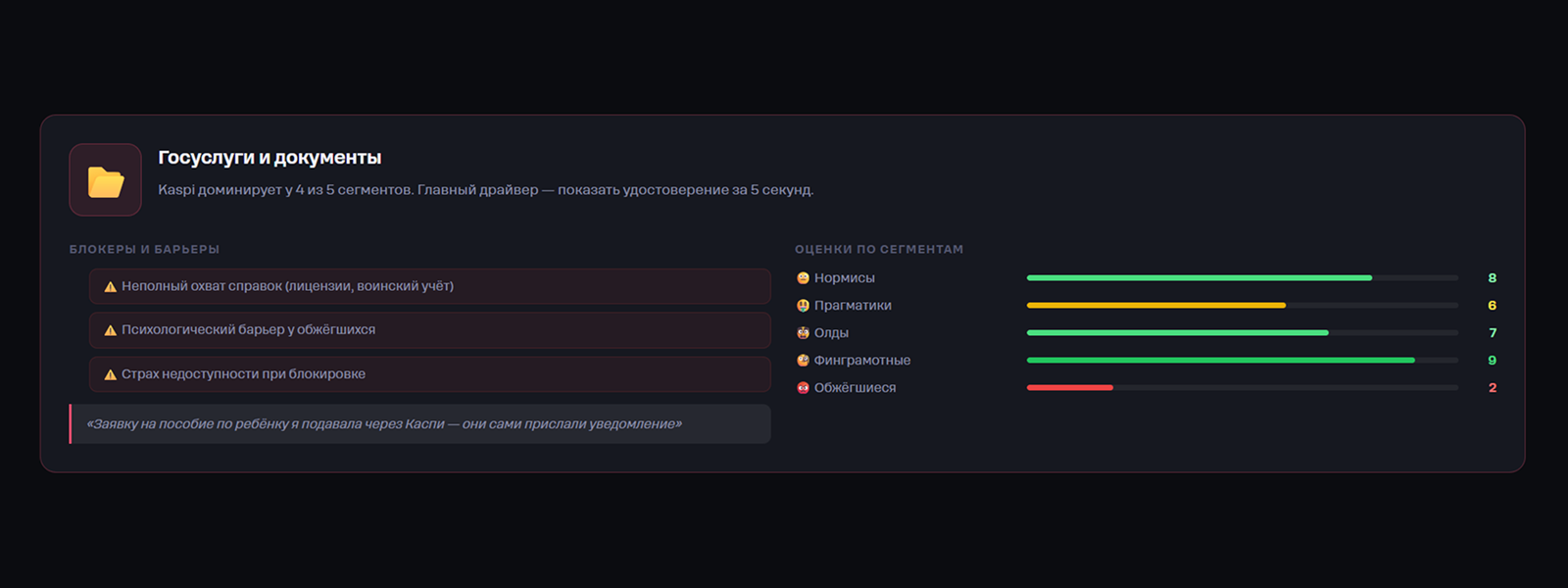
The “80/20” barrier and the shortage of specialized documents
Superapps handle basic requests perfectly (IDs, driver’s licenses) but fail with highly specialized documents (military records, employment contracts, licenses). This shortage forces users to periodically return to the official eGov Mobile app.
Fear of becoming a bank “hostage” during disputes
Users fear that if their accounts are blocked, cards seized, or they face legal disputes with the bank, they will simultaneously lose access to their digital government documents stored in that bank’s app. This psychological barrier forces many to keep eGov Mobile as a backup.
Weak synchronization of family data
Difficulties in automatically pulling up family members’ documents (like children’s birth certificates) or delays in updating government service statuses compared to official state registries reduce trust in the ecosystem’s stability.
Behavior models: from digital integration to personal data protection
In-depth interviews divided Kazakhstani users based on their attitude toward government services in superapps:
-
Inertia model (Normies and Older Users): They see government services in a bank as a natural extension of daily life. The older generation values the “one-button rule” for easily paying pensions and kindergartens. Normies are used to showing a QR ID from a bank app on demand, barely distinguishing between “bank” and “government.”
-
Cold calculation model (Pragmatists and the Financially Literate): They view government services in a bank as a strictly utilitarian necessity. They quickly complete required transactions (paying fees, fines) without brand loyalty, react harshly to any commissions, and instantly switch to the free eGov if the bank charges even a minimal percentage for a government service.
-
Survival and fear model (The Burned): They absolutely do not trust commercial banks to store their original government documents. Fearing data leaks, misuse of personal information, or blocks, they try to disable document integration in superapps and use only physical copies or the official eGov Mobile.
How it looks in practice
Marat shows his digital ID from a bank app at the post office to pick up a package—no need to carry a passport. But when he needed a police clearance certificate and a military ID, they weren’t in the superapp; he had to use eGov Mobile. Marat also keeps eGov “just in case.” He fears that during a dispute with the bank or an account freeze, he will lose access to both his money and his documents at once. For him, the bank’s government service is a convenient storefront for frequent needs, but not the only source for important ones.
FAQ
Why do banks beat eGov in speed but lose in data completeness?
Bank apps have better UX architecture and performance, but state eGov portals retain a monopoly on rare and highly specialized registries that banks cannot yet integrate.
Is it safe to store and present digital documents through a bank app?
Technically, data is transmitted through secure channels. However, users still face a psychological barrier: the fear of confidential information leaks and the risk of losing access to their ID if their bank account is blocked.
What should the ideal GovTech service in a commercial bank look like?
Users see it as a fully autonomous digital passport that automatically pulls data for all family members without delays or manual entry, where paying any state fees happens in one click and strictly without commissions.
Why don’t Kazakhstanis delete eGov Mobile, even if they use government services in a bank?
For two reasons. The bank covers only frequent documents (IDs, driver’s licenses) and fails with specific ones—military IDs, licenses, employment contracts. Plus, there is the fear of losing access to documents along with the account during a block. Therefore, eGov remains a backup for important items.
Original study: Rocket Tech: How Kazakhstanis use government services and documents in banking ecosystems


