

-
Fear of emergencies: The main barrier to booking remains the fear of facing a flight cancellation or delayed baggage in a foreign country alone, without prompt support from the bank.
-
Bonus pragmatism: High cashback and interest-free installments attract customers, but they regularly double-check prices on third-party aggregators because they distrust superapp fares.
Kazakhstan has made an unprecedented leap in fintech: banking apps have penetrated almost every area of life. Today, banking ecosystems (Kaspi Travel, Freedom Travel) have become full-fledged players in the travel market, displacing traditional agencies and global aggregators. The ability to buy a plane ticket in installments or get substantial cashback for a tour makes the bank the starting point of any trip. However, for most, the bank remains just a checkout counter that does not accompany the traveler from boarding to returning home.
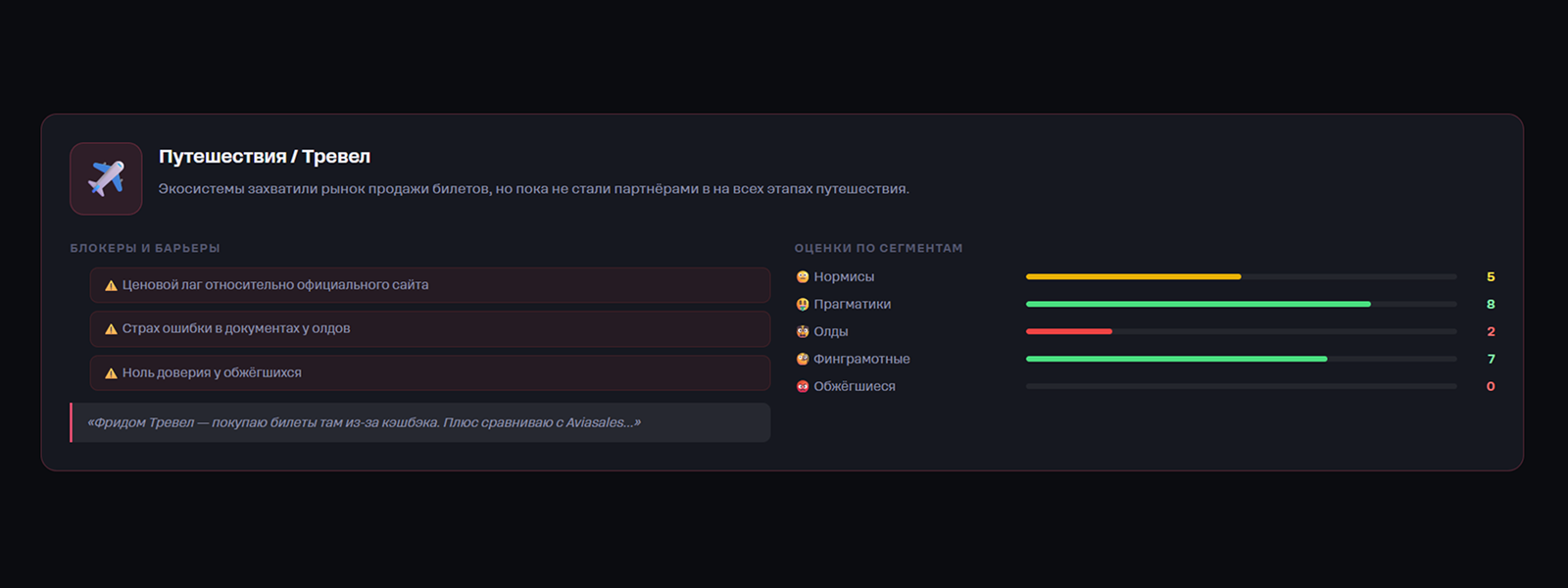
A large-scale UX study by the Rocket Tech team identified key barriers and five audience segments in travel services.
The Bottom Line
Integrating travel services into banking ecosystems has proven highly popular due to financial tools like installments and bonuses. Still, the main barrier remains the lack of 360-degree support on the road and the fear of complex ticket refund procedures. The future belongs to superapps that provide care during the trip, personalized notifications, and fair pricing without hidden markups.
Key Barriers: Fear of Flight Cancellations and Price Lags
Fear of changed plans and poor support
The main barrier is the fear of getting stuck with bank support when needing an emergency ticket refund or exchange. Users worry that in a critical moment, the superapp’s support team will fail to quickly resolve the issue with the airline, leaving them stranded abroad.
Price lags and illusory savings
Often, the base price in the bank app is higher than the fare on the airline’s official website. This forces pragmatists to spend time comparing and calculating the real benefit—whether the cashback and installments offset the markup. If the benefit seems doubtful, they abandon the superapp purchase.
Inability to combine miles and bonuses
Users get annoyed that when buying inside a superapp, they cannot simultaneously use airline miles (such as Nomad Club) and bank cashback. This reduces the service’s value for frequent flyers.
Behavioral Models: From Total Outsourcing to Mathematical Gain
In-depth interviews divided Kazakhstani users by their approach to buying travel services:
-
The inertia model (Normies and Old-timers): They view travel as a rare event and buy tickets in the superapp simply because of the familiar interface. The older generation often fears making a technical error when entering data online, so they entrust the purchase to relatives or use traditional ticket offices.
-
The cold calculation model (Pragmatists and the Financially Literate): They treat the purchase as a math problem. They look for options on external aggregators (Aviasales) but complete the transaction where they earn the maximum bonuses or get favorable installment terms during major sales (such as Kaspi Juma).
-
The survival and fear model (The Burned): They absolutely refuse to buy tickets through banking apps. Having once faced a flight cancellation or baggage delay where the bank shifted responsibility to the airline, they book flights exclusively on the carriers’ official websites to minimize middlemen.
How It Looks in Practice
Azamat is planning a vacation. He finds tickets in the bank’s superapp—with installments and cashback, it looks like a good deal. But before paying, he still opens Aviata.kz and the airline’s website: he compares the price and reads the refund conditions. Once, his flight was canceled, and the bank just threw its hands up, saying, “resolve it with the carrier.” Because of this, Azamat books major trips on the official website and only buys cheap tickets through the bank during sales like Kaspi Juma, where the savings are obvious. The superapp that takes on support during the trip and handles refunds for cancellations will win the expensive orders, too.
Why It Matters
In travel, peace of mind matters more than price. Customers stick with the bank that guides them through the entire journey: reminding them to check in, helping with flight delays, and not abandoning them in a foreign country when things go wrong.
FAQ
Why do Kazakhstanis compare bank prices with Aviasales before buying?
Because of regular price lags, where the base ticket cost in the superapp turns out higher than on external platforms. Users want to check if the promised cashback makes the bank purchase worthwhile.
What scares users most when buying tours through banking apps?
Complex refund algorithms during force majeure events. Consumers fear being left without prompt feedback from support in critical situations at the airport or abroad.
What should the ideal travel service inside a superapp look like?
Respondents see it as a reliable assistant that not only sells tickets but also accompanies them on the road: warning them about the boarding terminal on time, offering one-click insurance, and resolving issues with airlines in real time.
What makes Kazakhstanis bypass the bank to book expensive trips?
The fear of being left without help during a flight cancellation or delay. As long as the bank shifts these problems onto the carrier, the client only trusts it with cheap tickets. Expensive trips go to platforms that offer round-the-clock support and clear refund guarantees.
Original research source: Rocket Tech: How Kazakhstanis use travel services in banking ecosystems