

-
The bank as a cashier, not a navigator: Banking apps successfully handle payments but completely lose out to specialized services in navigation and trip planning convenience.
-
Debt triggers: Outstanding debt or bank-imposed freezes completely block a user’s desire to interact with transport services within that app.
For residents of modern metropolises in Kazakhstan, urban mobility has long gone digital. Banking ecosystems have successfully integrated payments for public transport, toll roads, and parking into their interfaces, turning the smartphone into a universal transit pass. Yet, a serious gap hides behind this outward convenience: banks excel as cashiers but rarely participate in the actual movement process—navigation, ride-hailing, or route planning.
A large-scale UX study by the Rocket Tech team identified key product barriers and audience segments with different logic for interacting with urban transport.
The bottom line
Banks have solved QR fare payments, but not the entire trip. People still have to keep multiple apps: one for the route, another for payment, and a third for a taxi.
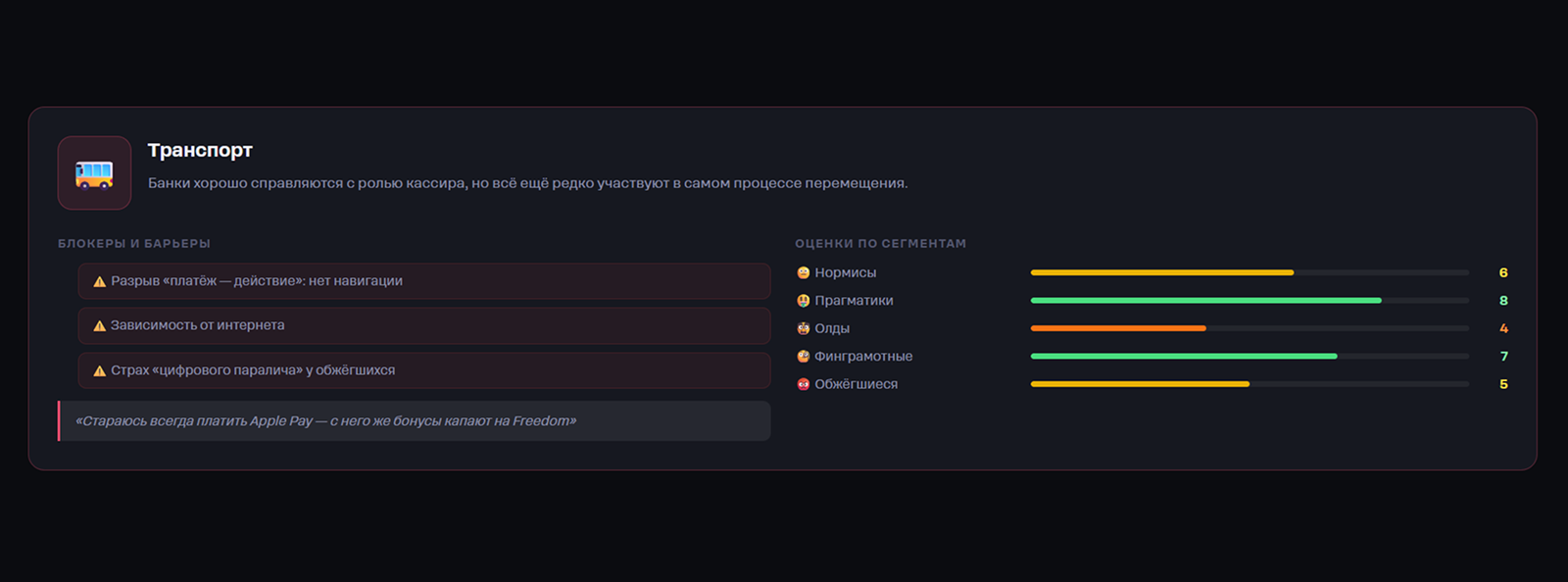
Where the transport scenario breaks in the bank
Fear of “digital paralysis”
A critical barrier for many users is the fear of getting stuck on a toll road, at a parking lot, or in public transport if the bank app or internet connection fails at the wrong moment. This forces clients to opt out of automatic deductions.
Negative associations and debt pressure
If a user has an active overdue loan or a court-ordered freeze on accounts in a specific bank, any transport features in that app cause stress. The client panics that money deposited for fares or parking will be instantly debited to cover the debt, leaving them unable to travel.
Interface and scenario gaps
Users find it inconvenient to check bus routes in one app (like CityBus or Onay) and pay the fare by scanning a QR code in another (the bank app). The lack of a unified “route-pay-ride” scenario reduces the value of superapps.
How it looks in practice
Morning in Almaty. Daniyar is rushing to a meeting: he opens 2GIS to see which bus goes downtown, then switches to his bank app to scan the QR code on the validator. Upon exiting, he needs a taxi—another app, Yandex Go. Three apps for one trip. And when a payment once “hung” on a toll road and the barrier didn’t open, Daniyar stopped trusting auto-payments altogether: now he keeps a separate balance on his Onay transit card “just in case.” The bank in his scenario is only a payment validator, not a companion for the whole trip.
The paradox is that Kazakhstanis are already used to paying: QR codes on validators, parking payments, and toll roads work almost everywhere. The failure lies in the “before” and “after” payment stages. The bank that adds a live map with transport arrivals, routes with transfers, and ride-hailing to the same screen will turn a one-off payment into a daily scenario. Along with it, the bank will get what a payment gateway lacks: movement data and a reason to open the app several times a day, rather than once a month for a payment. Technically, the foundation is already there: QR payments in transport work almost universally for Kazakhstani banks—only the navigation layer and partnership agreements with city operators like Onay are missing.
FAQ
Why do Kazakhstanis still use specialized apps (like Onay or Yandex Go) instead of banking services?
Specialized apps cover the basic need for navigation and real-time transport tracking. Banking apps currently only know how to process payments, depriving the user of the trip’s context.
How can banks reduce the fear of “digital paralysis” on toll roads and parking lots?
They need to implement local offline payment confirmation protocols, develop transparent systems for instant push notifications about auto-payment statuses, and guarantee uninterrupted service even with a zero balance, followed by a soft overdraft.
What should the ideal transport service in a superapp look like?
Kazakhstanis see the ideal service as a unified urban mobility hub that combines optimal route planning, a choice between transport modes (bus, subway, taxi, scooter), and automatic, seamless one-touch payment without unnecessary scanning.
What prevents a bank from becoming a unified transport app?
Not technology, but data fragmentation: routes, schedules, and ride-hailing belong to different players (Onay, 2GIS, Yandex). The bank needs to negotiate partnerships and give the user a complete “route → payment → ride” scenario, not just a payment gateway.
Original study: Rocket Tech: How Kazakhstanis pay for transport in banking ecosystems
