

For the modern Kazakhstani, leisure has long been digital: we plan weekends on our smartphones, listen to music on the go, and watch movies on streaming platforms. Banking ecosystems actively integrate ticketing services (Ticketon, Kino.kz) and offer subscription deals, trying to become the starting point for recreation. But behind the convenience of a one-stop ticket purchase lies a gap: banks successfully play the role of a cashier, but rarely become the place where content is actually consumed.
A large-scale UX study by the Rocket Tech team identified key product barriers and audience segments with different approaches to planning their free time.
Brief conclusion
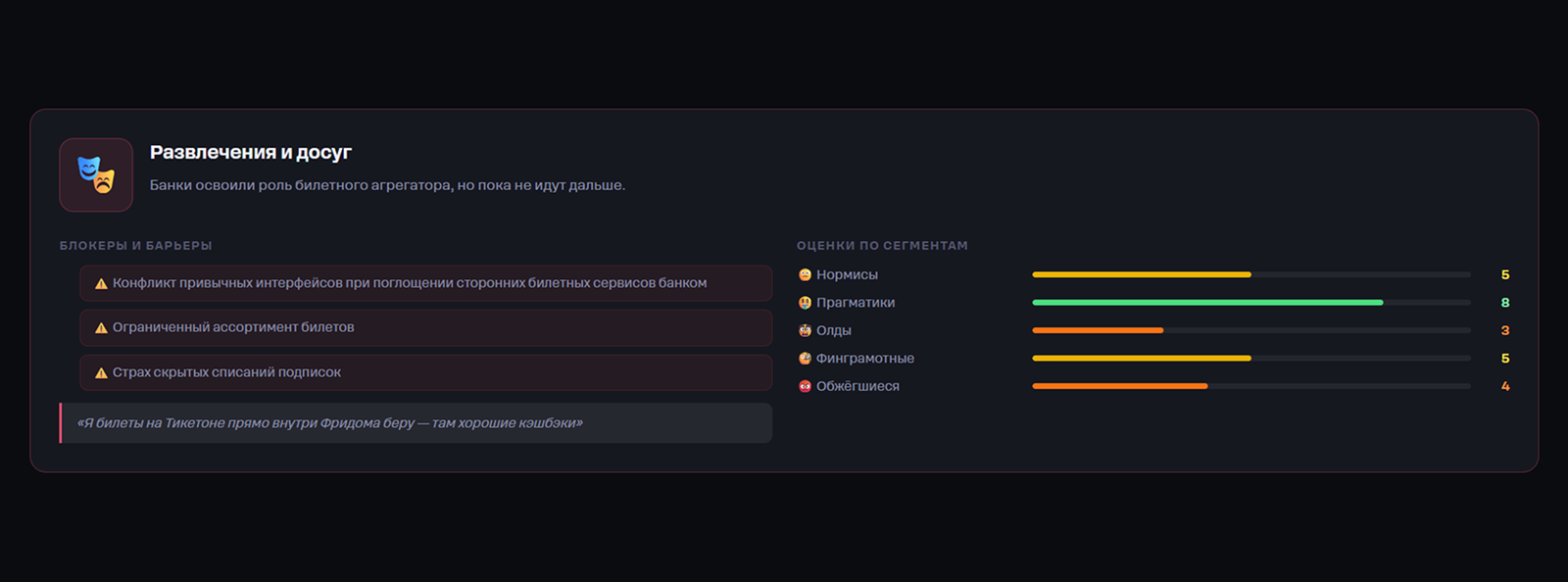
People willingly buy tickets through banks, but it stops at the checkout. When planning leisure, users feel uncomfortable seeing their balances and credit obligations nearby.
What keeps the bank in the “ticket office” role
The psychological barrier of a “serious interface”
Subconsciously, a bank is perceived as a place of strict financial control and obligations. When a user opens the app to buy weekend movie tickets and immediately sees a loan payment reminder or their total account balance, the festive anticipation is instantly ruined.
Fear of “hidden subscriptions” and forced auto-renewals
When buying tickets or testing new entertainment services in a bank app, clients panic about accidentally signing up for recurring hidden payments (like ticket insurance or streaming auto-renewals) that will be impossible or extremely difficult to disable in the app’s settings.
The ticket cancellation and refund problem
If a concert or movie screening is canceled, the user faces bureaucratic hell: the bank sends them to the final ticket operator to resolve the issue, and the operator sends them back to the bank. The lack of automatic, instant refunds directly in the app permanently kills the desire to buy tickets through a superapp.
How it looks in practice
Friday evening. Madina wants to buy two movie tickets for the weekend. She opens the banking app and the first thing she sees is a banner reading “loan payment due in 3 days” and her total account balance. The holiday mood fades. She buys the tickets, but next time she will go directly to Kino.kz—there are no debt reminders there. And when a screening was once canceled, she had to fight for a refund for a week: the bank sent her to the ticket operator, and the operator sent her back to the bank. Since then, entertainment and banking are different worlds for Madina.
At the same time, the audience is willing to pay for leisure through the bank—for the sake of installments, cashback, and one-stop shopping. The barrier is not the price, but the tone of communication: a strict financial interface and the fear of hidden auto-renewals. A bank that creates a separate “light” zone for entertainment, handles instant refunds for canceled events, and displays all subscriptions in a single list with one-click cancellation will capture this category almost without a fight. Competitor aggregators offer neither installments nor a familiar wallet nearby.
FAQ
Why are users afraid to subscribe to entertainment services inside banking apps?
The main trigger for distrust is opaque subscription management. Users fear the bank will deduct money without warning, and the “cancel subscription” button will be buried deep in settings or require a call to the support center.
How can banks build trust in their ticketing services?
They must fully automate and take ownership of the refund process when events are canceled or rescheduled. The client should receive funds back on their card instantly, without having to write applications to third-party ticket operators.
What should the ideal lifestyle service inside a banking ecosystem look like?
The ideal service is a personal free-time assistant. It offers a single dashboard to control all external subscriptions (Yandex Plus, Netflix, YouTube) with one-click cancellation, and delicately recommends events without overloading the user with ads and financial notifications during their downtime.
Why are banks losing the entertainment category despite the convenience of selling tickets?
Buying a ticket is a one-time action, but loyalty is built on emotion. As long as the app shows debts during leisure time and fails to handle refunds for canceled events, the user perceives the bank as a “cash register” rather than a leisure service—and leaves for specialized platforms.
Original research source: Rocket Tech: How Kazakhstanis use entertainment and leisure services in banking ecosystems
