

Closed banking systems force entrepreneurs into manual labor—transferring data between programs and multiplying the risk of critical errors. Open APIs change this, turning the bank from an isolated system into a business hub. A study on the digital maturity of SME banking in Uzbekistan shows how ready the market is for the Open Banking era.
Download the full research (PDF). Data on 20 Uzbekistan banks across 110 parameters, maturity ranking, and methodology.
The short answer
Open APIs allow banks to seamlessly exchange data with business systems: accounting, ERP, and tax authorities. Currently, only a few support full integration with 1C, SAP, and QuickBooks, and automatic synchronization with reporting is poorly developed. Ahead of Open Banking, closed systems lose to those offering clients flawless data exchange with third-party services.
Why APIs save labor
Every manual statement transfer to accounting wastes time and creates a potential error that will later surface in reporting. APIs remove the middleman: data flows automatically between the bank and business systems. For the client, this means less routine and fewer risks; for the bank, it secures a place at the very center of the company’s digital perimeter.
Openness is also a strategic choice. A bank that shares data through standardized interfaces becomes a platform around which services are built; a closed bank remains just another payment provider.
What the research showed
Category leaders according to Rocket Tech research (“Integration and automation”): 1. Ipak Yuli Bank, 2. Kapital Bank, 3. Aloqabank.
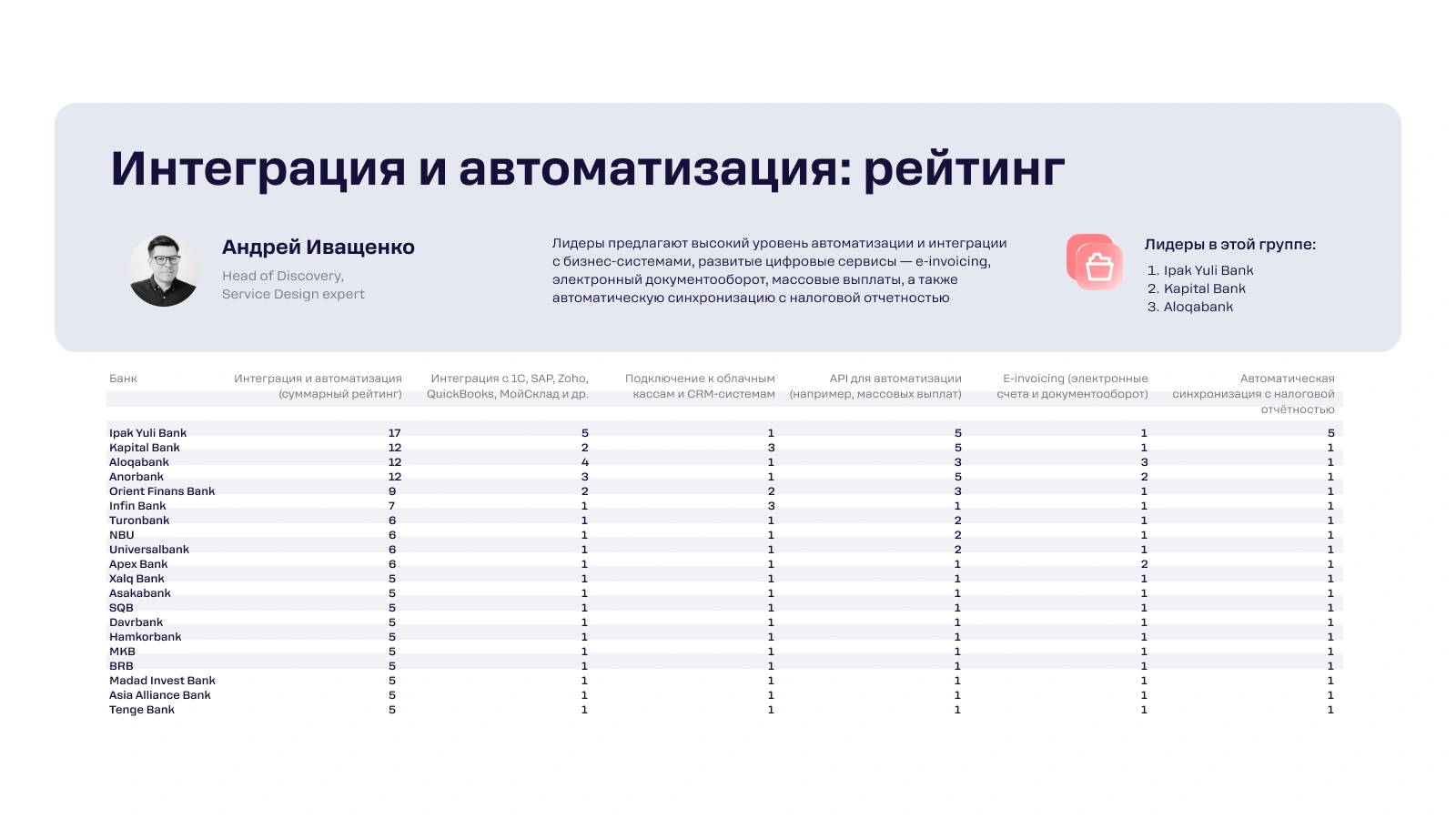
Integrations between banks and business systems remain poorly developed.
Closed systems
Businesses are forced to manually transfer data between the bank and accounting programs, which is slow and prone to errors.
Few deep integrations
Only a few players support full integration with 1C, SAP, and QuickBooks, even though these systems are the working standard for accounting.
Weak reporting exchange
Bulk payouts and automatic synchronization with tax reporting are poorly implemented, leaving businesses with manual reconciliation.
How it looks in practice
An accountant closes the month. In one scenario, they download a statement, manually transfer transactions to 1C, reconcile them line by line, and separately prepare data for taxes—a full day of painstaking work where any typo will surface in the report. In another, the bank connects to the accounting system via a connector: transactions enter 1C automatically, reconciliation takes minutes, and reporting data flows through an established channel without manual export. The accountant focuses on control rather than copying rows—and errors drop simply because manual transfer disappears.
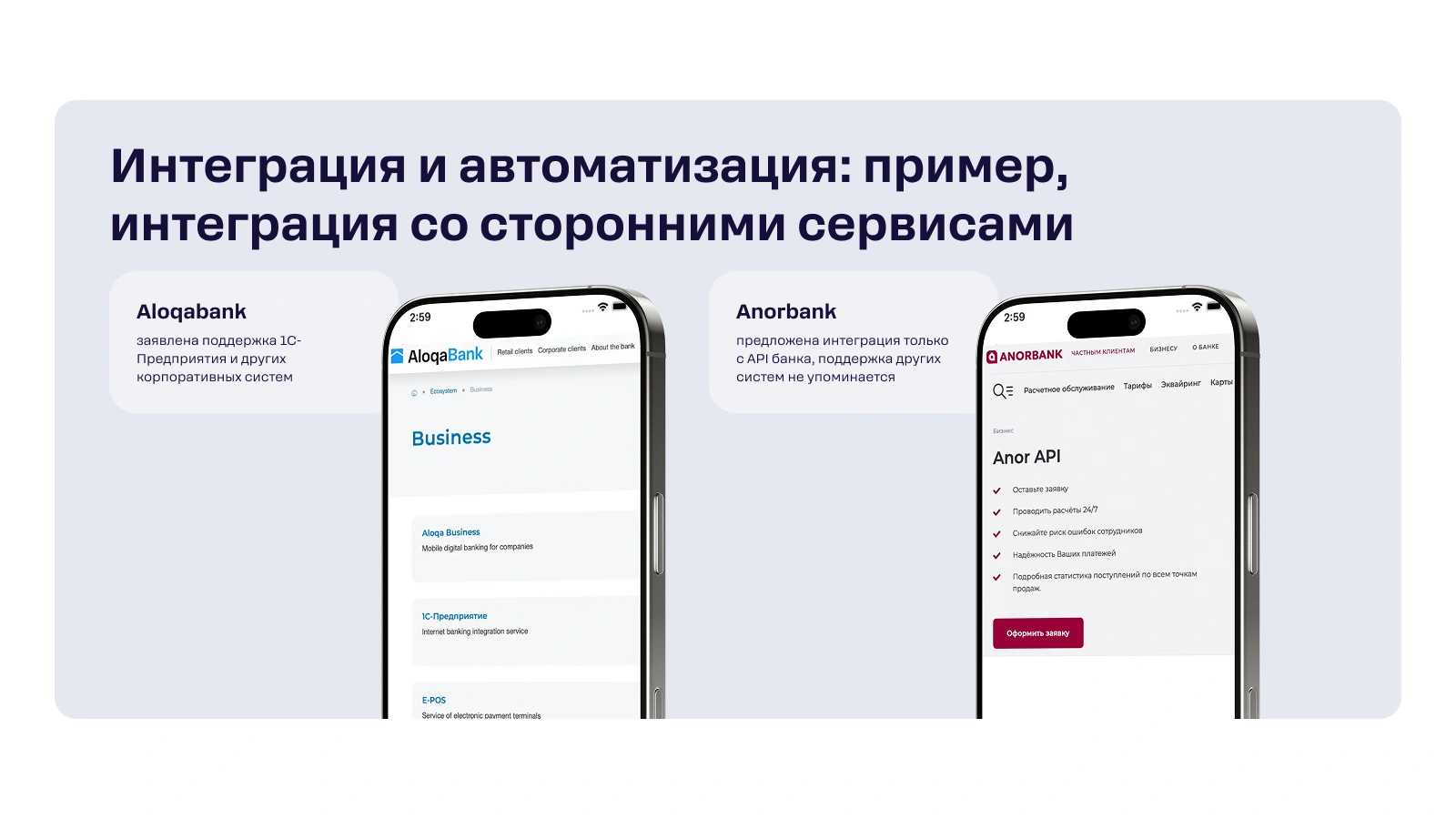
How to solve this
- Connectors to ERP systems and setting up automatic two-way data exchange.
- APIs for bulk payouts and electronic document management.
- Automatic data transfer channels to tax systems for SMEs.
Rocket Tech develops API platforms and connectors, embedding the bank into the client’s 1C, ERP, and accounting systems—turning an isolated system into a hub that anchors the entire digital perimeter of the business.
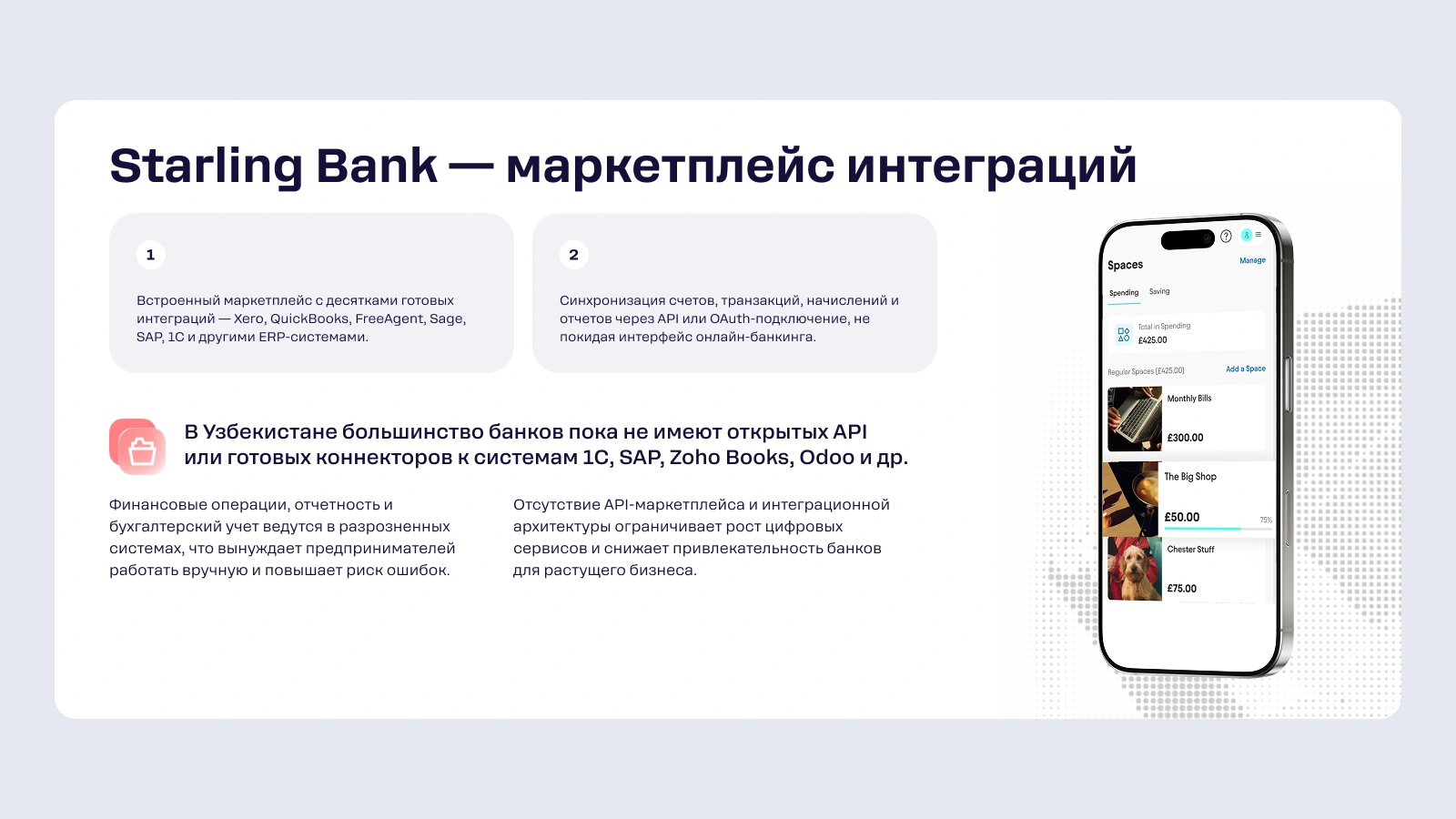
Why this matters for banks
A bank with open APIs becomes the integration point for all the client’s business systems—making it much harder to replace. This brings retention, lower operational load, and a new layer of monetizable services. In the logic of Open Banking, platforms win over closed systems, and APIs are the entry ticket.
FAQ
What is Open Banking?
A model where a bank provides data and payment functions to trusted third-party services via standardized APIs with the client’s consent, creating an ecosystem around the account.
Why integrate a bank with 1C or ERP?
So payments, statements, and documents sync automatically, without manual transfer and errors, saving the accounting department time.
What is a connector?
A ready-made module that links the bank with an external system (accounting, ERP) and sets up automatic data exchange between them.
Why is an open bank better than a closed one?
An open bank becomes a platform around which services are built, retaining clients through integrations; a closed bank remains an interchangeable payment provider.
Is it safe to share data via API?
Yes, if the exchange uses standardized interfaces with client consent and access control—this is exactly how the Open Banking model works.
These are insights from Rocket Tech’s research on the digital maturity of SME banking in Uzbekistan.
