

Kazakhstan made an unprecedented leap in fintech: in just a few years, the country transitioned from cash to digital transactions. Automatic spending categorization, expense charts, and monthly reports have become the standard for Kaspi, Freedom, Halyk, and BCC. This allows users to see their spending structure without collecting paper receipts. However, behind the attractive charts lies a gap between “viewing statistics” and actual budget management.
A large-scale UX study by the Rocket Tech team identified key product barriers and five audience segments with different approaches to financial planning.
The bottom line
Kazakhstani banks made spending analytics look good, but passive: they show the past and offer no guidance on what to do next. The main barriers are “categorization inertia,” distrust of auto-imports, and the lack of a unified cross-bank picture. Advanced users stick to third-party spreadsheets. Loyalty will go to the superapp that offers proactive advice and end-to-end planning instead of simple retrospective statistics.
Key barriers: categorization inertia and interbank blindness
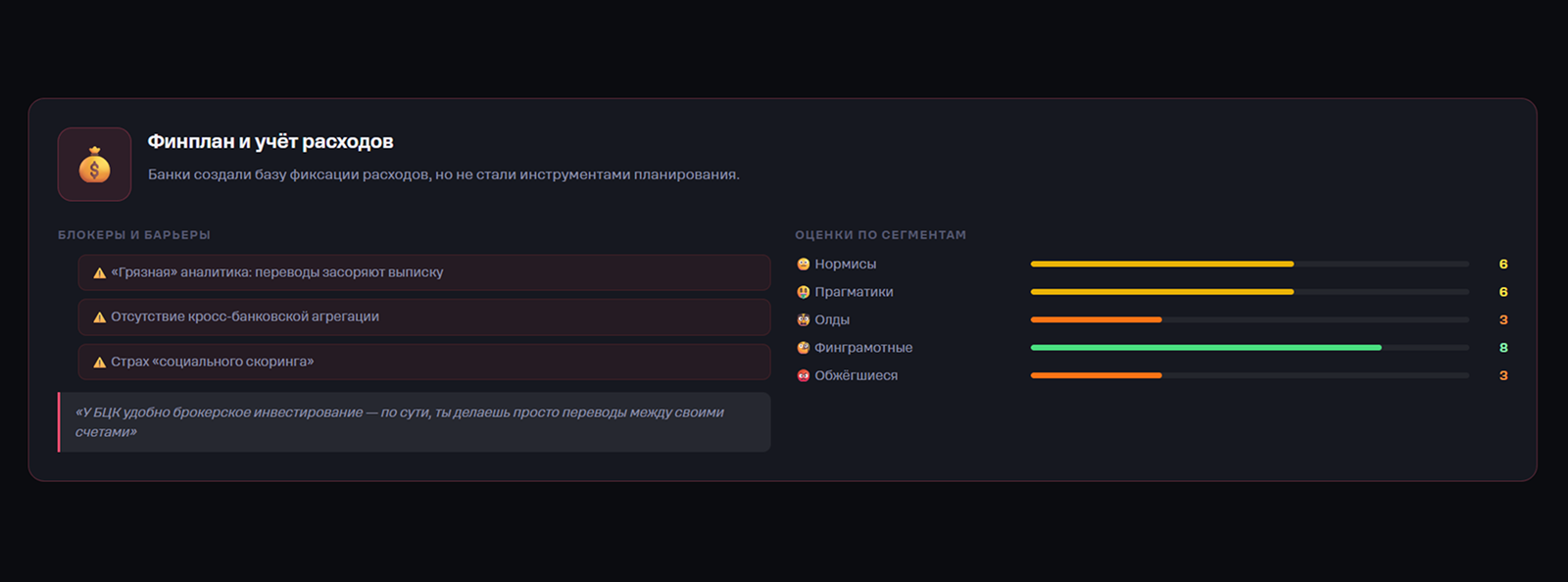
Categorization inertia and distorted statistics
The main unique barrier occurs when a user spots a spending category error (for example, a cafe lunch labeled as “Groceries”) but lacks the motivation or a convenient interface to fix it. As a result, the analytics start to “lie,” and the user stops checking them, losing trust in the tool.
The “interbank blindness” phenomenon and budget dilution
Due to rigid interbank barriers and a lack of end-to-end analytics, users have to split their capital across multiple financial institutions for cashback and favorable installment terms. The absence of a single screen displaying balances and expenses across all banks creates “interbank blindness” and complicates budget control.
The technological fragility of auto-imports
Users often abandon built-in analytics due to technical instability: auto-imports regularly break or pull data incorrectly. This forces financially literate users to consciously switch to external programs (like ZenMoney) or track their finances in Google Sheets.
Behavioral models: from passive observation to strict control
In-depth interviews divided Kazakhstani users by their attitude toward financial planning:
-
Inertia model (Normies and Old-timers): Expense tracking is a curious extra feature for them, not a system. They check charts situationally (for example, at the end of the month wondering “where did the money go”). They rarely plan a budget themselves, fear complex financial spreadsheets, and prefer keeping basic lists in smartphone notes or relying entirely on intuition.
-
Cold calculation model (Pragmatists and the Financially Literate): They view expense tracking as a tool to maximize personal gain. They manually set monthly limits, keep detailed records in third-party software or Excel spreadsheets, and strictly monitor the effectiveness of their bonus and cashback strategies.
-
Survival and fear model (The Burned): They completely distrust automatic expense analysis. Fearing that incorrect account linking will cause unwanted charges, they disable all automatic subscription services, avoid setting personal budgets within banks, and double-check every transaction manually.
How it looks in practice
Timur tracks his budget in a Google Sheet, even though he has cards from three banks with “smart” analytics. The reason is simple: the first bank’s app records a cafe lunch as “Groceries,” the second bank doesn’t see the first bank’s card spending at all, and no one compiles the necessary report on “how much was spent on food this month across all accounts.” Every Sunday, Timur manually enters transactions into his spreadsheet—the only place showing the full picture. The bank that learns to pull spending from all cards and stops “lying” about categories will take over this manual labor, and with it, Timur’s daily attention.
Why it matters
As long as the app only shows what has already been spent, it loses to Excel. The winning bank will shift from retrospective charts to future-focused tips and aggregate expenses across all cards into a single screen—fixing the current interbank blind spot.
FAQ
Why do users still track budgets in Excel when banks offer spending charts?
This happens due to distrust in automatic categorization (which often makes mistakes) and the “interbank blindness” phenomenon—banking apps cannot aggregate spending data from all of a user’s cards into a single interface.
What is the biggest obstacle preventing banking analytics from becoming a full-fledged financial advisor?
Built-in services only show what has “already happened” but do not prompt the user to act. They lack proactive tools: future benefit calculators, personalized spending optimization tips, and gamification elements.
What does the ideal expense tracking service look like to Kazakhstanis?
Users envision it as an intelligent and accurate assistant that categorizes transactions without errors, accounts for balances in third-party banks, and provides practical savings advice without overloading the interface with ads.
Why do “smart” bank analytics lose to a standard Excel spreadsheet?
A spreadsheet shows the full picture across all accounts and doesn’t “lie” about categories because the user fills it out themselves. Bank analytics only see their own cards and frequently mislabel expenses. Until these two problems are solved, financially literate users will return to manual tracking.
Original research source: Rocket Tech: How Kazakhstanis use financial planning and expense tracking in banking ecosystems


