

For small and medium-sized businesses, a bank is no longer just a place to store money. Companies expect a partner that adapts to their structure, rather than forcing them into rigid legacy processes. A study on the digital maturity of SME banking in Uzbekistan shows that customer service remains the most noticeable and underestimated area for improvement among most players.
Download the full research (PDF). Data on 20 Uzbekistan banks across 110 parameters, maturity ranking, and methodology.
The Short Answer
Customer service in SME banking measures how much a bank simplifies a business’s daily operations: fast onboarding, transparent pricing, personal support, and managing multiple legal entities from a single dashboard. The market lacks flexibility and personalization, while leaders are already shifting to a “bank-as-a-partner” model. Mature service reduces churn and turns the app into the company’s financial control center.
Why a Single Account Is No Longer Enough
Retail clients stay for convenience and emotion; corporate clients stay for time savings and predictability. A business opens an account not for the account itself, but to pay, hire, and grow faster. Once everyone offers basic features, competition shifts from pricing to service quality. The bank that onboards a company faster, explains costs more transparently, and consolidates all of an owner’s legal entities in one window retains the client.
Crucially, the decision to switch banks in B2B is rational and collaborative: the CFO compares actual dashboard experience, not advertising. Every extra step in service is not just an annoyance, but a measurable reason to leave for a competitor who is “clearer and faster.”
What the Research Showed
Category leaders according to Rocket Tech research (“Terms of Service”): 1. SQB, 2. Xalq Bank, 3. Anorbank.
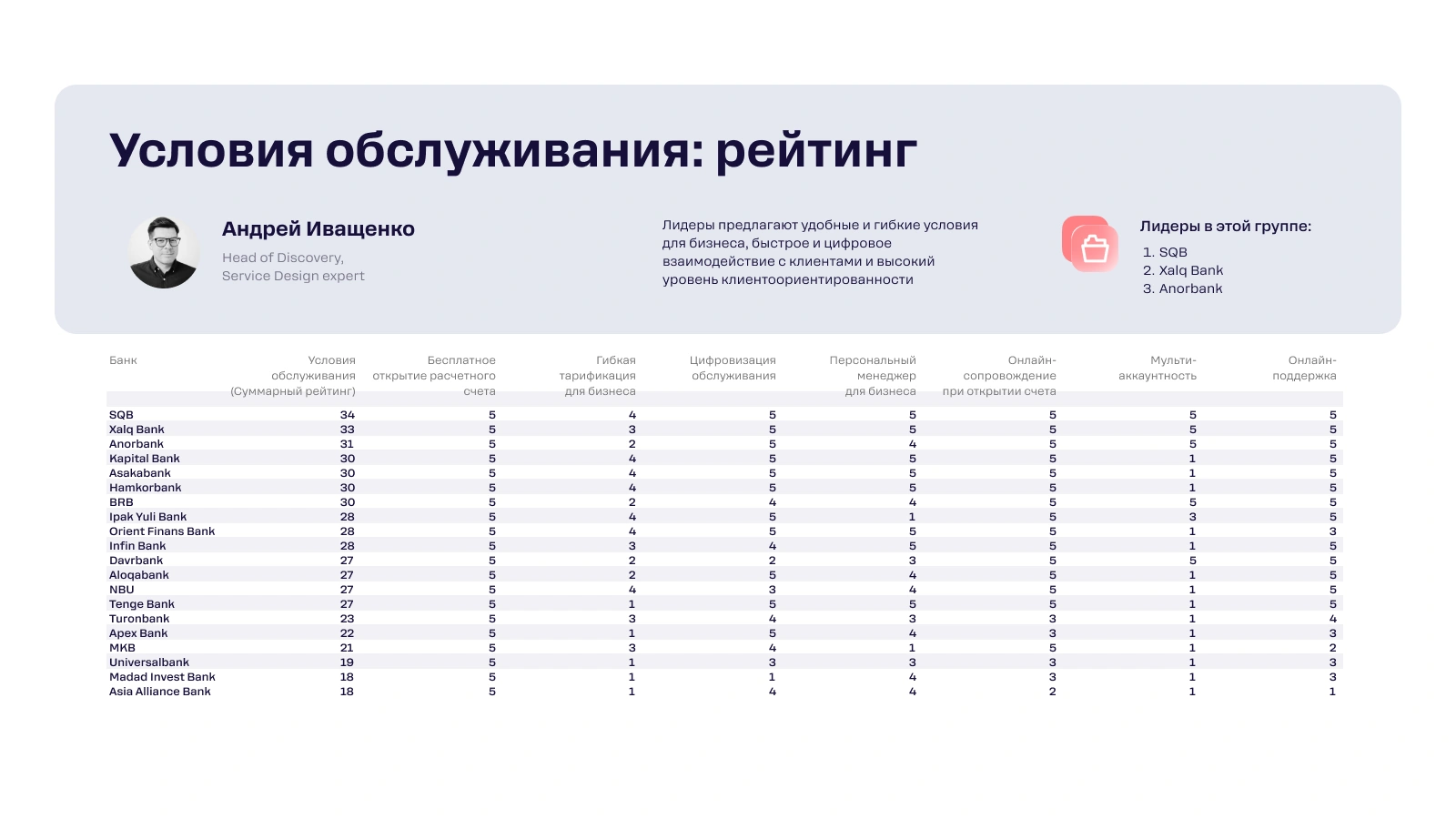
App analysis revealed three systemic gaps.
Onboarding and Pricing
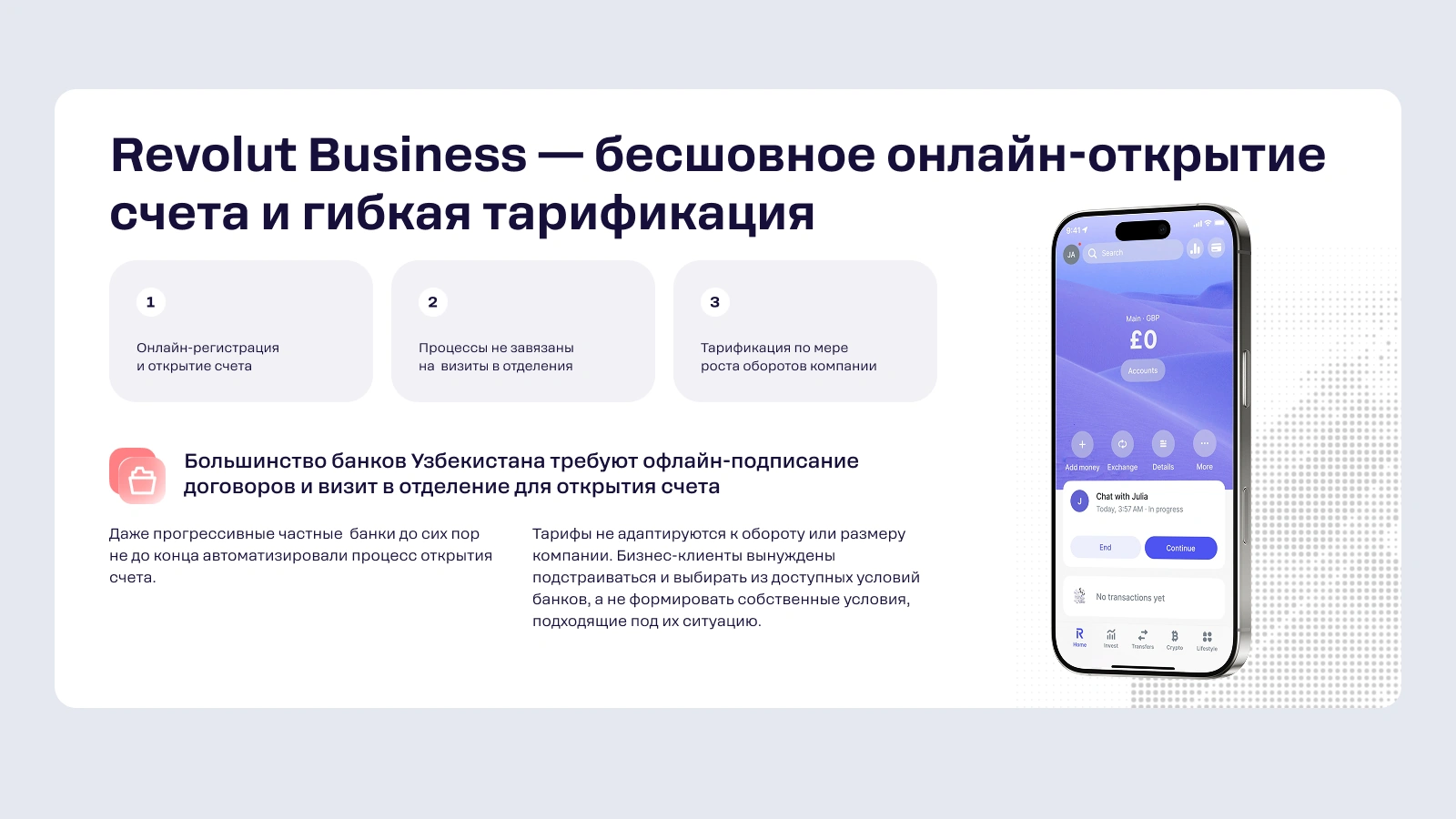
The market suffers from opaque pricing, and full digitization at the onboarding stage is still scarce. Companies struggle to understand the final cost of service upfront, and opening an account often requires branch visits and paperwork. There is a lack of flexible pricing plans tailored to different business segments, from micro-entrepreneurs to medium-sized enterprises.
Personal Approach
Dedicated personal managers and tailored support models remain rare. Yet, knowing a real person is assigned to the company with a clear channel for resolving issues builds long-term trust in the bank.
Multi-Account Management
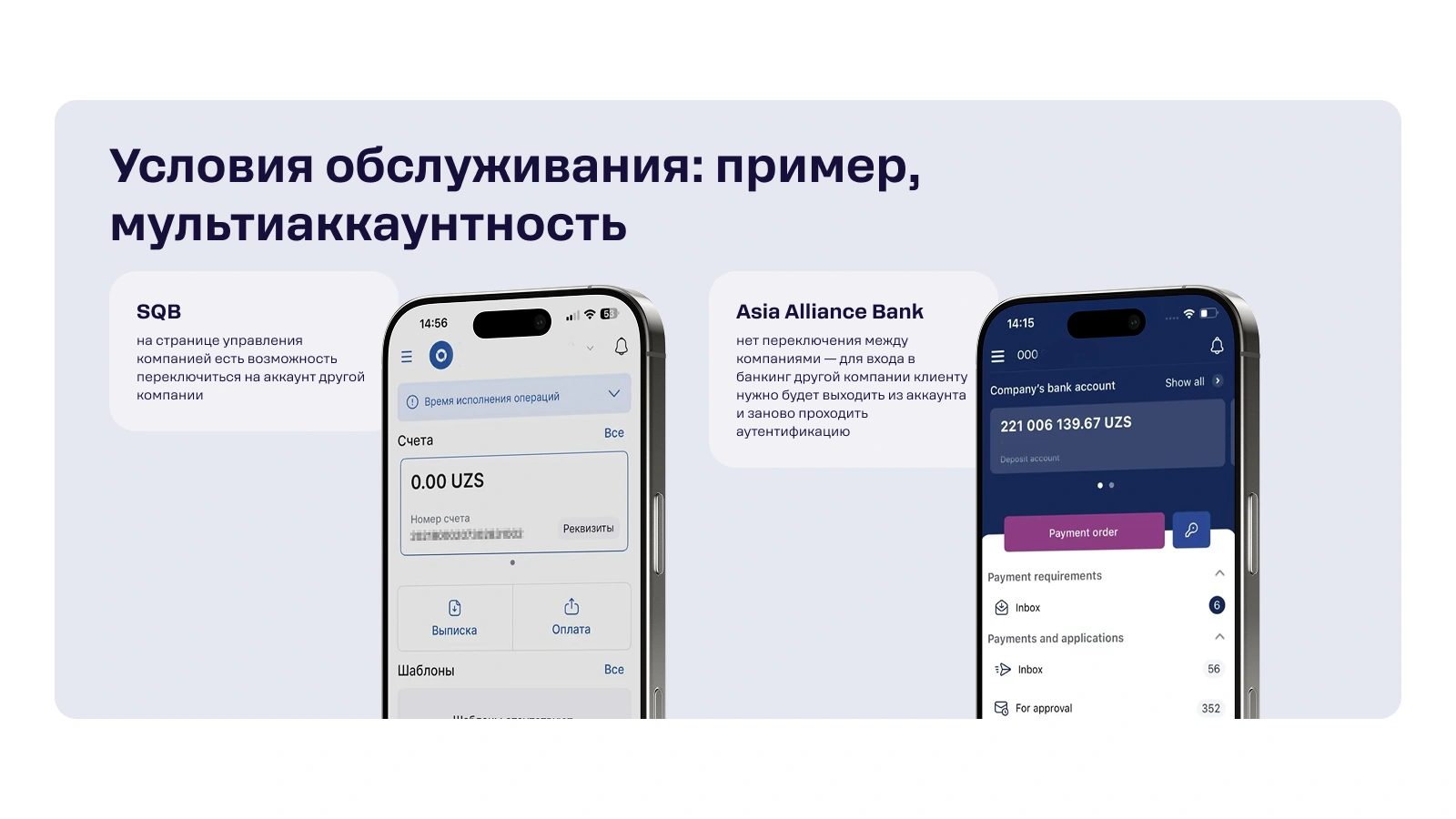
Managing accounts for multiple companies, branches, and currencies from a single dashboard is mostly found among the leaders. An owner running several legal entities often has to maintain separate logins and switch between them, resulting in a direct loss of time.
How It Looks in Practice
Imagine an owner with two companies and a sole proprietorship. In one bank, this means three separate logins, three sets of details, and constant switching just to get an overall financial picture. Opening an account for a new legal entity requires another branch visit and a stack of documents, and when asked about fees, the manager answers vaguely: “It depends on the transactions.” In another bank, the same owner sees all three businesses in one dashboard, opens a new account online via eKYC in minutes, and understands the service cost upfront through transparent pricing. The difference is not a single feature, but the time and frustration spent on routine tasks.
How to Fix It
The gap between leaders and the rest is closed not by cosmetic changes, but by rebuilding the customer journey:
- Custom pricing packages, where clients control costs based on their transaction profile instead of choosing from rigid “boxes.”
- Relationship Banking model focused on retention and support, rather than one-off product sales.
- A unified dashboard for managing legal entities, branches, and currencies, and eKYC for fully automated onboarding without branch visits.
At Rocket Tech, we design onboarding and dashboards around saving the client’s time. We analyze the actual user journey and rebuild scenarios so the service retains rather than frustrates.
Why It Matters for the Bank
Complex onboarding and opaque pricing mean expensive support, slow new company connections, and easy churn to competitors. Conversely, a bank that supports a client as a partner gains a higher LTV and a natural platform for cross-selling loans, acquiring, and services. In the SME segment, where products are largely similar, service quality becomes a sustainable competitive advantage.
FAQ
What is customer service in SME banking?
It is everything surrounding the account: onboarding speed and transparency, pricing flexibility, personal support, and the ability to manage multiple legal entities from one dashboard. In B2B, it is measured by the client’s saved time, not just polite support.
What is relationship banking?
A model where the bank builds long-term relationships with a business and earns revenue through retention and support, rather than one-off transactions. The client gets a clear communication channel and a “growth partnership” logic.
Why does a business need a unified dashboard for multiple companies?
Owners often run multiple legal entities and branches. Switching between separate logins wastes time and increases the risk of errors. A unified dashboard with multi-account management removes this friction.
What is eKYC?
Remote client identification that allows opening an account and passing verification entirely online, without a branch visit or paper documents.
How do you know a bank’s service is costing a business money?
Look at the time and number of steps required for standard tasks: opening an account, adding an employee, getting a support response, or consolidating turnover across multiple legal entities. If it is slow and opaque, the client pays the cost with their time.
These are insights from Rocket Tech’s research on the digital maturity of SME banking in Uzbekistan.
