

The more complex a business structure, the more granular access settings it expects from its banking dashboard. A basic “view/edit” matrix is no longer enough for a growing company—it needs a model that reflects the actual distribution of roles and responsibilities. A study on the digital maturity of SME banking in Uzbekistan shows where the market lags in access architecture.
Download the full research (PDF). Data on 20 Uzbekistan banks across 110 parameters, maturity rating, and methodology.
The short answer
Mature access management means flexible roles for accountants and executives, collaborative payment processing with multi-level approvals, and full activity auditing. Currently, collaborative features are mostly implemented by market leaders, ready-made role scenarios are absent, and transaction history is minimal. The more complex the client’s business, the more critical fine-tuning rights and limits becomes.
Why the basic role matrix breaks down
A three-person company only needs a couple of access levels. But once accounting, financial control, and multiple signatories appear, a simple “view/edit” setup stops reflecting internal processes. Someone needs to draft a payment, someone else needs to approve it, and others only need to view reports. Without flexible roles, a business faces a bad choice: hand out excessive permissions and risk security, or bottleneck everything through one person and slow down operations.
As the company grows, this conflict escalates—and a bank that fails to provide granular settings starts hindering the business.
What the research showed
Category leaders according to Rocket Tech research (“Role Management”): 1. Tenge Bank, 2. Ipak Yuli Bank, 3. Xalq Bank.
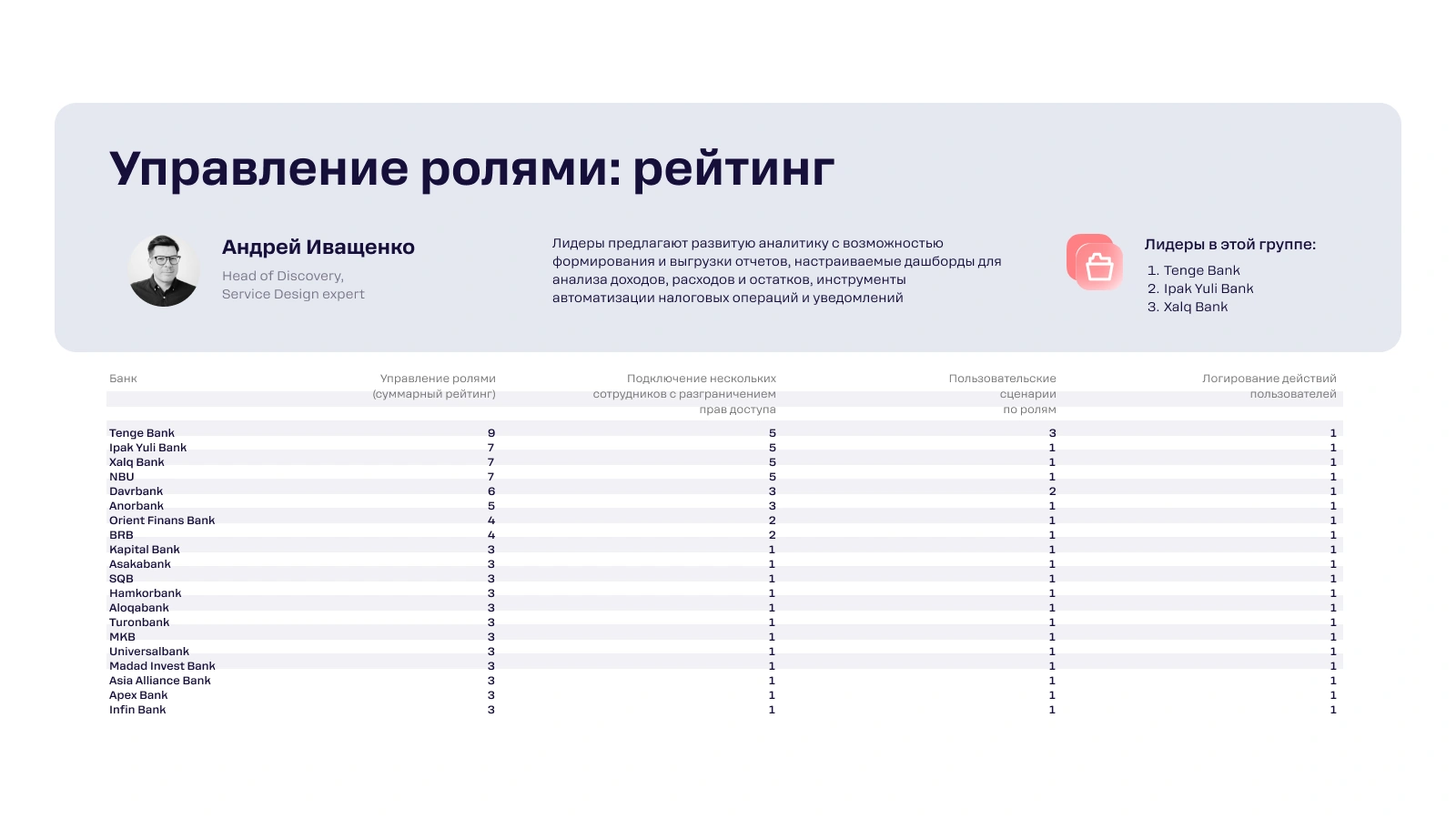
The data shows that access in most banks is designed for a single user.
Collaborative work
Support for simultaneous work by multiple employees is mostly implemented by the leaders in the ranking.
No ready-made roles
There is a lack of preset scenarios for standard roles—like accountant or executive—which complicates and slows down employee onboarding.
Weak auditing
Activity tracking mechanisms and transaction histories are minimal. Without them, ensuring transparency and investigating incidents is difficult.
How it looks in practice
A company’s team is growing: an accountant, a financial director, and an owner join, each with their own area of responsibility. In one bank, access is essentially shared. For the accountant to draft payments, they are given full rights, meaning they can also send them without oversight. The owner either accepts the risk or signs everything themselves, becoming a bottleneck. In another bank, everyone has a specific role: the accountant drafts the payment, the CFO approves it, the owner views reports, and the audit system logs who did what. A new employee gets the necessary rights in one click using a preset scenario. Security and speed no longer conflict.
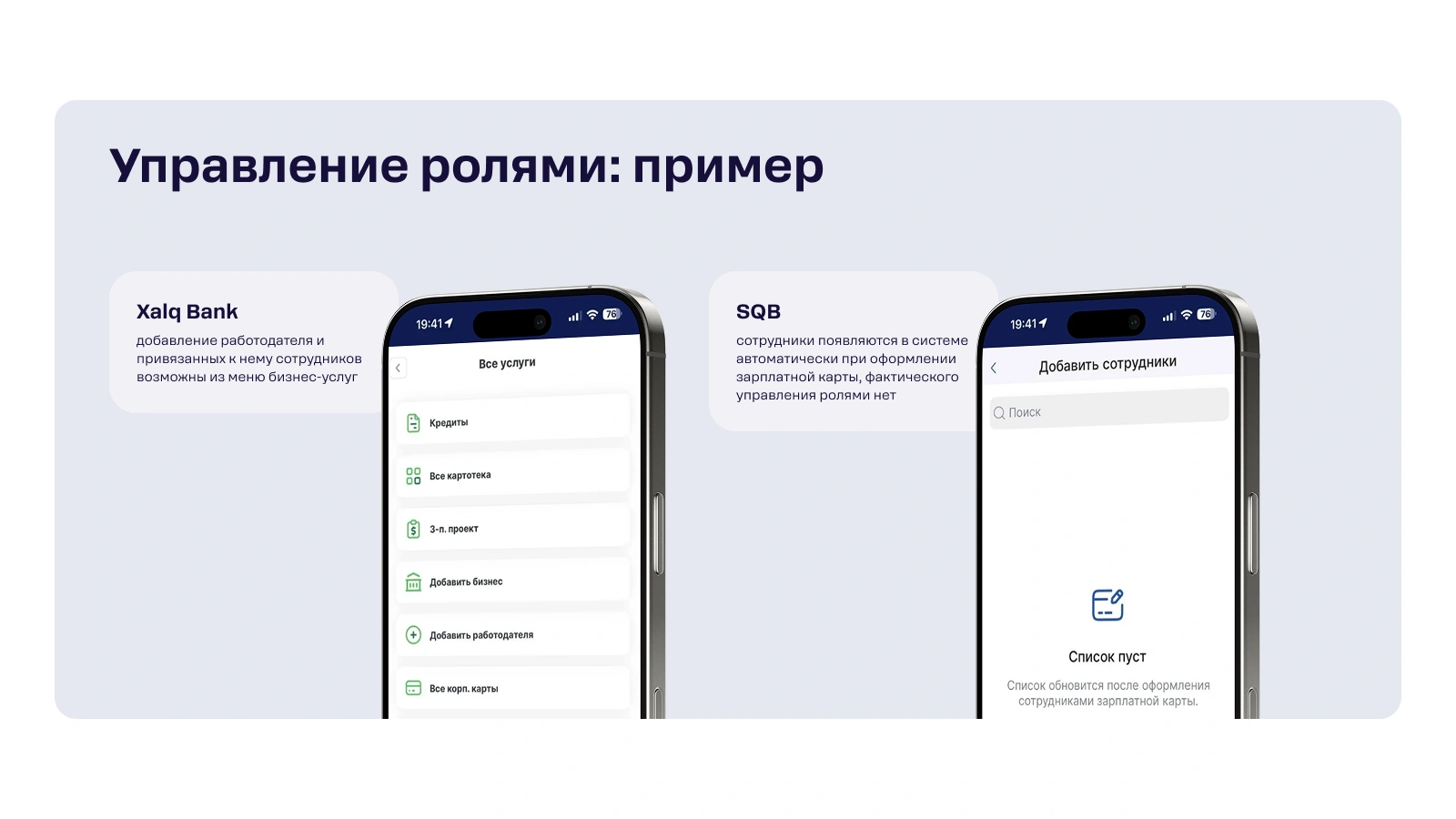
How to solve this
- Full team access with permission segregation and multi-level payment approvals.
- Ready-made role scenarios for quick onboarding of new employees without manually configuring every permission.
- Advanced auditing—logging and monitoring actions for transparency and control.
Rocket Tech helps banks build this role model: flexible permissions, collaborative payment processing with multi-level approvals, and an activity log—all designed so onboarding a new employee takes minutes, not hours.
Why this matters for the bank
Flexible roles and auditing provide both security and convenience. A business trusts a bank where it can precisely distribute permissions and see who did what. For growing companies, this is often a deciding factor: the larger the client, the more important granular access settings become, and the more costly it is for the bank to lose them over a primitive role model.
FAQ
What is a role model in a banking dashboard?
A permission system where each employee has a specific role (drafting a payment, approving, or view-only) corresponding to their function in the company.
Why is transaction auditing necessary?
To see who performed an action and when. This increases transparency, simplifies incident investigation, and reduces the risk of abuse.
What does multi-level payment approval provide?
One employee drafts a payment, another approves it. This reduces the risk of errors and fraud in large transactions.
Why do ready-made role scenarios speed up work?
A new employee receives the appropriate set of permissions in one click, without manual configuration for each access point. Onboarding takes minutes, not hours.
When is it time for a business to switch to flexible roles?
As soon as more than one person handles finances and a “draft / approve / control” division emerges, a basic permission matrix is no longer enough.
These are insights from Rocket Tech’s research on the digital maturity of SME banking in Uzbekistan.
